The first year with a puppy goes fast, and a lot of it is front-loaded. Most of the vet visits, the shots, the gear and the training happen in the first few months. I put this page together to answer the two questions people seem to ask most: what needs doing, and when? And what will it cost? The checklist follows the American Animal Hospital Association’s (AAHA) life stage guidelines, and the costs start from the ASPCA’s figures, updated to 2026 prices.
The short answer
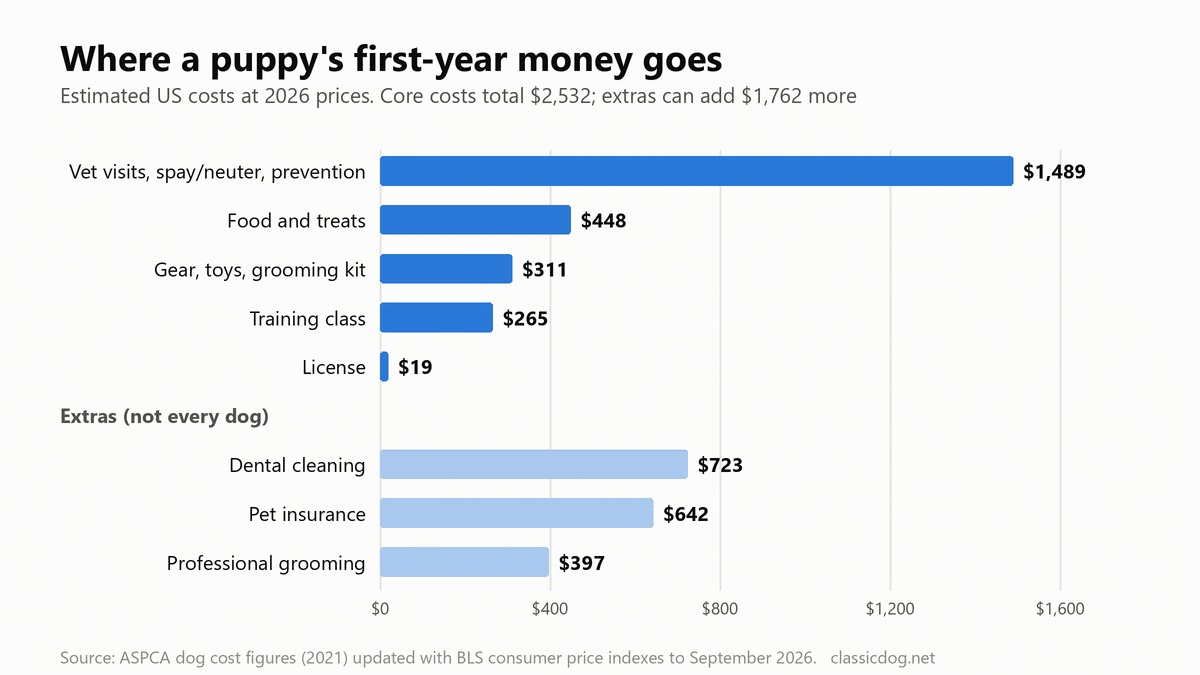
Expect frequent vet visits until about 4 to 5 months of age, a core combination vaccine booster within one year after the last dose of the initial puppy series, and a lot of training in between. For money, plan on about $2,500 for the core costs of a puppy’s first year at 2026 prices. If you add pet insurance, professional grooming and a dental cleaning, my estimate comes to about $4,300. Both figures are the ASPCA’s 2021 budget items adjusted for price rises, not measured national averages.
I’m not a vet and I don’t own a dog. This is a summary of published guidelines, so your vet’s advice for your own puppy comes first. AAHA itself says each dog should be treated as an individual, not run through a formula.
Before your puppy comes home
- Book the first vet visit. AAHA’s checklist for puppies includes a microchip or other permanent ID, a check for problems present from birth, and a talk about how often to come back.
- Buy the basics: a crate, a collar and leash, a carrier, food and a few safe chew toys. These are in the cost table below.
- Puppy-proof the house. AAHA flags plants and swallowed objects as hazards at this age. Our guide to toxic plants for dogs lists the common ones.
- Pick a food and a schedule. AAHA suggests feeding plans that match your puppy’s breed and size. The dog food calculator gives a starting amount.
8 to 16 weeks: vet visits and socialization
AAHA’s checklist suggests puppy exams every 3 to 4 weeks. That fits with the vaccine series, which AAHA’s guidelines finish at 16 to 20 weeks. Our dog vaccine schedule explains which shots come when.
Parasites are a big deal in puppies. AAHA’s checklist calls for deworming every 2 weeks, starting at 2 weeks of age, until the puppy goes on year-round parasite control. It suggests starting a heartworm preventive as early as the product label allows, usually by 8 weeks, and flea and tick control usually from 6 to 8 weeks. Expect more stool checks in the first year than later in life.
This is also the heart of the socialization window, and it’s the part I’d least want to get wrong. It starts before your puppy comes home: AAHA says breeders shape behavior in the first weeks, and the American Veterinary Society of Animal Behavior (AVSAB) calls the first three months of life the most important time for socialization. AAHA’s guidelines say puppies need positive, structured exposure to people, places, animals and things during their sensitive periods. They also cite a survey that found only about a third of puppies got exposure to people and dogs outside the home during those critical weeks. And AAHA’s behavior guidelines say there’s no medical reason to delay puppy classes until the vaccine series is done, as long as the puppy is kept away from sick animals, basic hygiene is followed and the puppy eats a high-quality diet. Ask your vet about a puppy class that fits those rules.
AVSAB gives more detail. It says puppies can start classes as early as 7 to 8 weeks, as long as they’ve had at least one set of vaccines 7 days or more before the first class and a first deworming, and stay up to date on vaccines during the course. It also advises keeping young puppies out of dog parks and other busy places used by dogs whose health isn’t known.
One warning from the same guidelines: puppies don’t usually “outgrow” problems. If your puppy seems very frightened in a situation, slow down and talk to your vet, rather than pushing through.
4 to 6 months: teeth, more shots, house rules
Adult teeth come in during these months. AAHA says home tooth care can start once the permanent teeth have come through, and warns that a puppy losing its baby teeth may find brushing uncomfortable, so keep it gentle. Your vet will also check for baby teeth that don’t fall out.
The vaccine schedule continues. AAHA’s 2022 guidelines give leptospirosis as two doses: the first at 12 weeks or later, the second 2 to 4 weeks after it. Rabies follows your state’s law. Crate training and house training carry on too. AAHA’s checklist lists crate training as something to discuss with your vet for safety, comfort and housetraining.
6 to 12 months: the teenage phase
AAHA defines the puppy stage as lasting from birth until rapid growth stops, at about 6 to 9 months depending on breed and size. After that, your dog is a young adult, and AAHA says the stretch from about 6 months to 3 years can be the hardest for owners as the dog matures. Jumping, barking and mouthing are common. Keep going with training.
- Weigh and check body shape. The puppy weight estimator and the body condition score guide help you track growth.
- Heartworm and tick-borne disease tests start once a year from 7 to 12 months of age, in AAHA’s checklist.
- Spay or neuter timing. Talk this through with your vet, who can explain the options for your dog’s breed and size.
- The one-year booster. AAHA calls for a single dose of the core combination vaccine within 1 year after the last dose of the puppy series, and the same for leptospirosis. It’s easy to forget.
What the first year costs
The ASPCA published a dog cost list in 2021. Prices have risen a lot since then, and vet services faster than most things. I updated each item with the Bureau of Labor Statistics price index that matches it: vet services for vet costs, pet food for food and treats, pet supplies for gear, and pet services for training and grooming. Insurance and the license use the overall inflation rate. These are the same numbers behind our dog cost calculator, where you can change any line to match your area.
Two vet lines can look like a double count. The ASPCA lists a one-time “initial medical” cost (vaccines, etc.) and a yearly “routine medical” cost (vaccines, wellness visits, etc.). Its first-year total includes both, and so does mine. The index values I used are listed in the sources.
| Item | Type | ASPCA 2021 | 2026 estimate |
|---|---|---|---|
| Food | Yearly | $300 | $373 |
| Routine vet care (vaccines, exams) | Yearly | $225 | $325 |
| Flea, tick and heartworm prevention | Yearly | $185 | $267 |
| Toys | Yearly | $37 | $42 |
| Treats | Yearly | $60 | $75 |
| License | Yearly | $15 | $19 |
| Grooming supplies | Yearly | $28 | $32 |
| Spay or neuter | One-time | $300 | $434 |
| First vaccines and vet visits | One-time | $300 | $434 |
| Collar, leash, harness | One-time | $60 | $68 |
| Microchip | One-time | $20 | $29 |
| Carrier | One-time | $50 | $56 |
| Crate | One-time | $60 | $68 |
| Training class and materials | One-time | $200 | $265 |
| Grooming tools | One-time | $40 | $45 |
| Pet insurance (optional) | Extra | $516 | $642 |
| Professional grooming (optional) | Extra | $300 | $397 |
| Dental cleaning (optional) | Extra | $500 | $723 |
| Core first year (no extras) | $1,880 | $2,532 | |
| First year with all extras | $3,196 | $4,294 |
A worked example: the ASPCA’s 2021 figure for spay or neuter surgery was $300. The vet services price index rose from a 2021 average of 288.769 to 417.438 in September 2026, a factor of about 1.4456. So $300 × 1.4456 = $434.
Limits of these numbers
These are national estimates. Prices in a big city can be much higher than in a small town, and a large breed eats far more than a small one. The table also leaves out boarding (the ASPCA puts it at $25 a day in 2021), dog walkers, fences and emergency care. One accident in the first year can cost more than everything on the table. That’s worth thinking about before you decide on insurance.
If I had to pick one thing to get right in the first year, it would be the socialization window. Most other things on this list can be caught up later. The weeks when a puppy learns that the world is safe can’t.
Sources
- American Animal Hospital Association. 2019 AAHA Canine Life Stage Guidelines: Life Stage Checklists. aaha.org
- American Animal Hospital Association. 2019 AAHA Canine Life Stage Guidelines: Behavior. aaha.org
- American Animal Hospital Association. 2019 AAHA Canine Life Stage Guidelines: Canine Life Stage Definitions. aaha.org
- American Animal Hospital Association. 2022 AAHA Canine Vaccination Guidelines (updated 2024). aaha.org
- ASPCA. Cutting Pet Care Costs (2021 update). aspca.org
- American Veterinary Society of Animal Behavior. Position Statement on Puppy Socialization. avsab.org (PDF)
- U.S. Bureau of Labor Statistics. Consumer Price Index, U.S. city average, not seasonally adjusted. 2021 annual average and September 2026: veterinarian services (CUUR0000SS62054) 288.769 and 417.438; pet food and treats (CUUR0000SS61031) 156.225 and 194.440; pets, pet supplies and accessories (CUUR0000SS61032) 117.157 and 132.164; pet services (CUUR0000SS62053) 210.525 and 278.694; all items (CUUR0000SA0) 270.970 and 336.940. data.bls.gov
Last reviewed: November 14, 2026. Written by Santosh Mahajan. This page summarizes published guidelines and isn’t veterinary advice. Your vet decides the right schedule for your puppy. See the Disclaimer and the Editorial Policy.