
The scale can tell you what your dog weighs, but not whether that weight is right for them. A 70 lb Labrador might be lean and fit, or carrying 15 lb of fat, depending on the dog’s frame. That’s why vets use a body condition score. It takes two minutes, you need nothing but your hands and eyes, and once you’ve learned it you can check your own dog at home.
This guide explains the 9-point scale vets use, what each score means in extra weight, and what the research says about why it matters.
The 9-point body condition score
The 2021 AAHA Nutrition and Weight Management Guidelines recommend that vets use the 9-point scale, scored in whole numbers, for every pet at every visit. It’s the same scale shown on the World Small Animal Veterinary Association (WSAVA) body condition chart. A score of 4 or 5 is ideal. Below 4 is underweight, and above 5 is overweight.
AAHA’s guidelines also link each score to body fat measured by DEXA scans. Each step up the scale adds about 5% body fat, and each point above 5 means the dog is roughly 10% heavier than its ideal weight. Some vets use a 5-point scale instead, where each half point equals one point on the 9-point scale.
| Score (of 9) | What you’d notice | Body fat | Compared with ideal weight |
|---|---|---|---|
| 1 | Ribs, spine and hip bones obvious from a distance. No fat at all, clear muscle loss. | — | Severely underweight |
| 2 | Ribs, spine and hip bones easy to see. No fat you can feel, some muscle loss. | — | Very underweight |
| 3 | Ribs easy to feel and may show. Top of the spine visible, very obvious waist and tuck. | — | Underweight |
| 4 | Ribs easy to feel under a thin layer of fat. Clear waist from above, belly tucked up. | 15–19% | Ideal |
| 5 | Ribs easy to feel without extra fat. Waist visible behind the ribs, belly tucked up from the side. | 20–24% | Ideal |
| 6 | Ribs felt under a slight extra layer of fat. Waist still there but less obvious. | 25–29% | About 10% over |
| 7 | Ribs hard to feel under heavy fat. Fat over the lower back and tail base, little or no waist. | 30–34% | About 20% over |
| 8 | Ribs only felt with firm pressure, if at all. No waist, no tuck, belly may bulge. | 35–39% | About 30% over |
| 9 | Large fat deposits over the chest, spine and tail base, and on the neck and legs. Belly clearly swollen. | 40–45% or more | About 40% over or more |
How to check your dog at home
You need to look and touch. Long or thick coats hide a lot, so with a fluffy dog, the touching part matters more than the looking.
1. Feel the ribs. Lay your flat hands on either side of your dog’s chest and move them gently. At an ideal weight you can feel each rib easily with only a thin layer of fat over them, a bit like feeling the knuckles on the back of your hand. If you have to press firmly to find them, your dog is carrying extra fat. If the ribs stand out sharply with nothing over them, your dog may be too thin.
2. Look from above. Stand over your dog while they’re standing. You should see a waist: the body narrows behind the ribs before the hips. If the sides run straight back or bulge out, that’s a sign of extra weight.
3. Look from the side. At a healthy weight, the belly line rises from the bottom of the chest toward the back legs. This is called the abdominal tuck. A belly that hangs level or sags points to a higher score.
4. Check the base of the tail and lower back. On the WSAVA chart, noticeable fat over the lower back and around the base of the tail starts at a score of 7, and gets heavier from there.
Then pick the score that matches best. If you’re torn between two, AAHA’s guidelines advise whole numbers, so pick the closer one rather than writing 6.5.
Turning a score into a target weight
Because each point above 5 is about 10% over ideal, the score gives you a rough idea of how much weight to lose. AAHA’s 2014 weight management guidelines give an example: a 45 kg (about 99 lb) Labrador with a score of 8 is about 30% overweight, and its ideal weight is roughly 32 kg (about 70 lb). That’s nearly 30 lb of fat on one dog.
Here’s a smaller example. Say a beagle weighs 33 lb and you score them a 7. That’s about 20% overweight, so a sensible first target is somewhere around 26 to 28 lb. Your vet can refine this, because the score is an estimate and dogs vary in build.
If your dog has always been weighed at the vet, there’s an easier route. AAHA suggests checking the medical records for your dog’s past weights and scores. A weight from a time when the vet recorded an ideal score is often the best target of all.
Why a point or two matters: the lifespan study
It’s tempting to think a slightly chubby dog is just a well-loved dog. The best evidence I found says otherwise. In 2019, researchers from WALTHAM, Banfield Pet Hospital and the University of Liverpool looked at more than 50,000 neutered pet dogs from 12 breeds seen at about 900 vet hospitals in North America. They compared dogs recorded as overweight throughout middle age with dogs that stayed at a normal weight.
In every breed, the overweight dogs had a shorter median lifespan. The gap was biggest in small breeds. Overweight male Yorkshire Terriers lived a median of 13.7 years, compared with 16.2 years for those at a normal weight, a difference of about two and a half years. The smallest gap was in German Shepherds, at about five months for males.
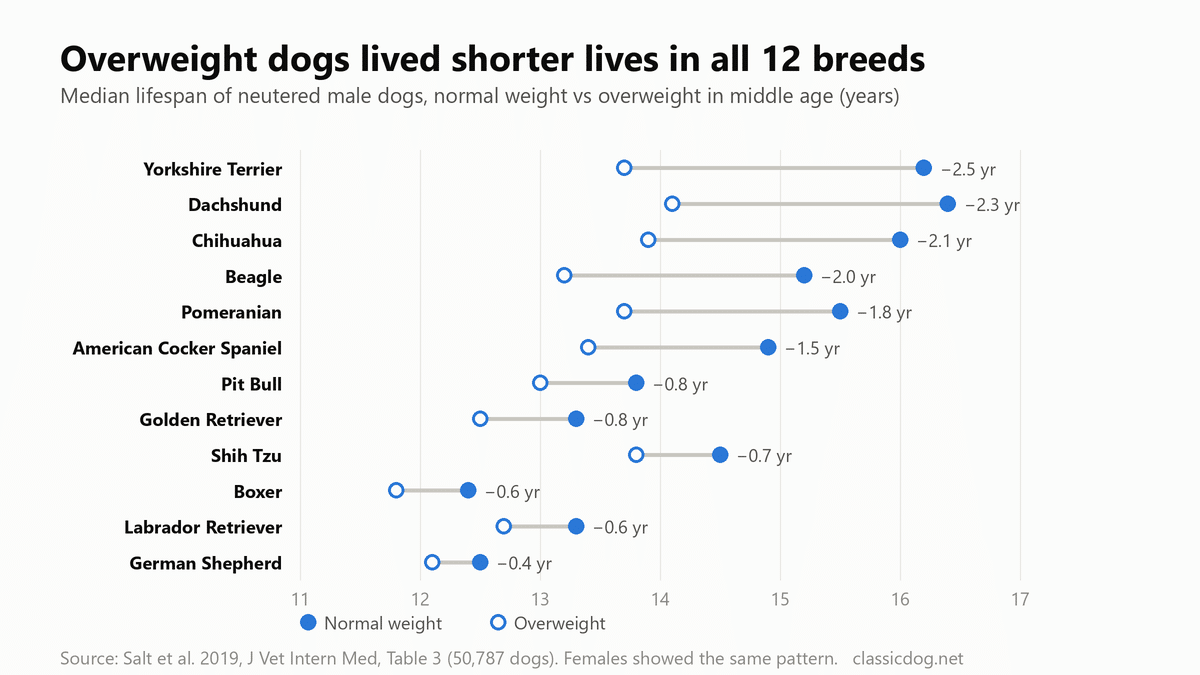
This was an observational study, so it shows a strong link rather than proving that the weight itself shortened these lives. Also, “overweight” in this study came from vets’ records using a simpler three-level scale (thin, normal, heavy), not the 9-point score. Still, the pattern held in all 12 breeds, which makes it hard to wave away.
AAHA’s 2014 guidelines note that up to 59% of dogs and cats are overweight, making it the most common nutrition problem vets see. If your dog scores a 6 or 7, you’re in large company.
Where the score falls short
It measures fat, not muscle. An older dog can lose muscle along the spine and hips while keeping their belly fat. WSAVA’s muscle condition chart, developed at Tufts University, points out that a dog can be overweight and still have significant muscle loss. Vets check the two separately, and you should mention it to your vet if your dog’s back or hips feel bonier than they used to.
Very obese dogs go off the top of the scale. AAHA’s guidelines say the score is limited once body fat goes above about 45%, and vets use other tools for those dogs.
Dogs come in very different shapes. A deep-chested sighthound and a broad, stocky breed won’t look the same from above even at the same score, so the outline can mislead you. For unusual shapes, lean more on what you feel over the ribs, and ask your vet what ideal looks like for your dog.
It’s a judgment, not a measurement. Two people can score the same dog differently. Scoring your dog the same way every month is more useful than worrying whether today’s score is exactly right.
What to do next
If your dog scores a 4 or 5, keep doing what you’re doing, and check again every month or so. If they score a 6 or higher, start with what they eat, including treats and table scraps. The dog food calculator shows a daily calorie target, and has a weight-loss setting that bases calories on the target weight rather than the current one. Please talk to your vet before starting a weight-loss plan, especially if your dog scores 8 or 9, has gained weight without eating more, or has joint problems. Weight gain can sometimes come from a medical problem like an underactive thyroid.
And if your dog scores 3 or lower, or is losing weight without you trying, that’s a reason to see your vet soon rather than a feeding question.
Sources
- Cline MG, et al. 2021 AAHA Nutrition and Weight Management Guidelines for Dogs and Cats: Screening Evaluation. aaha.org
- Brooks D, et al. 2014 AAHA Weight Management Guidelines for Dogs and Cats. Journal of the American Animal Hospital Association. 2014;50(1):1–11. aaha.org (PDF)
- World Small Animal Veterinary Association. Body Condition Score: Dog, and Muscle Condition Score: Dog. wsava.org
- Salt C, Morris PJ, Wilson D, Lund EM, German AJ. Association between life span and body condition in neutered client-owned dogs. Journal of Veterinary Internal Medicine. 2019;33(1):89–99. pmc.ncbi.nlm.nih.gov
Last reviewed: October 17, 2026. Written by Santosh Mahajan. This guide explains how vets assess body condition and isn’t veterinary advice. Please ask your vet to confirm your dog’s score and target weight. See the Disclaimer and the Editorial Policy.