Every pet insurance website will tell you it’s worth it. That’s their job. What I wanted was a plain way to check the math myself: how big do the vet bills have to get in a year before a policy pays back more than it costs? So I built this calculator. You type in the numbers from a real quote, pick a vet bill to test, and it shows what you’d pay with the policy and without it.
Pet insurance break-even calculator
Copy the numbers from a quote you’re looking at. Then enter the vet bills you want to test, and I’ll show what you’d pay in one year with the policy and without it.
US average for dog accident and illness cover in 2025 was $836 a year, about $70 a month (NAPHIA).
From your quote. $250 is only an example.
The share of the bill the insurer pays after the deductible.
Policies differ. Check the wording of yours. Per-condition deductibles aren’t modeled.
Only bills the policy would cover. Routine care and pre-existing conditions are usually left out.
A simple one-year model: premiums plus your share of covered bills, compared with paying the bills yourself. Real policies have waiting periods, exclusions and price rises with age. Read the policy wording. This is not financial or veterinary advice.
The short answer
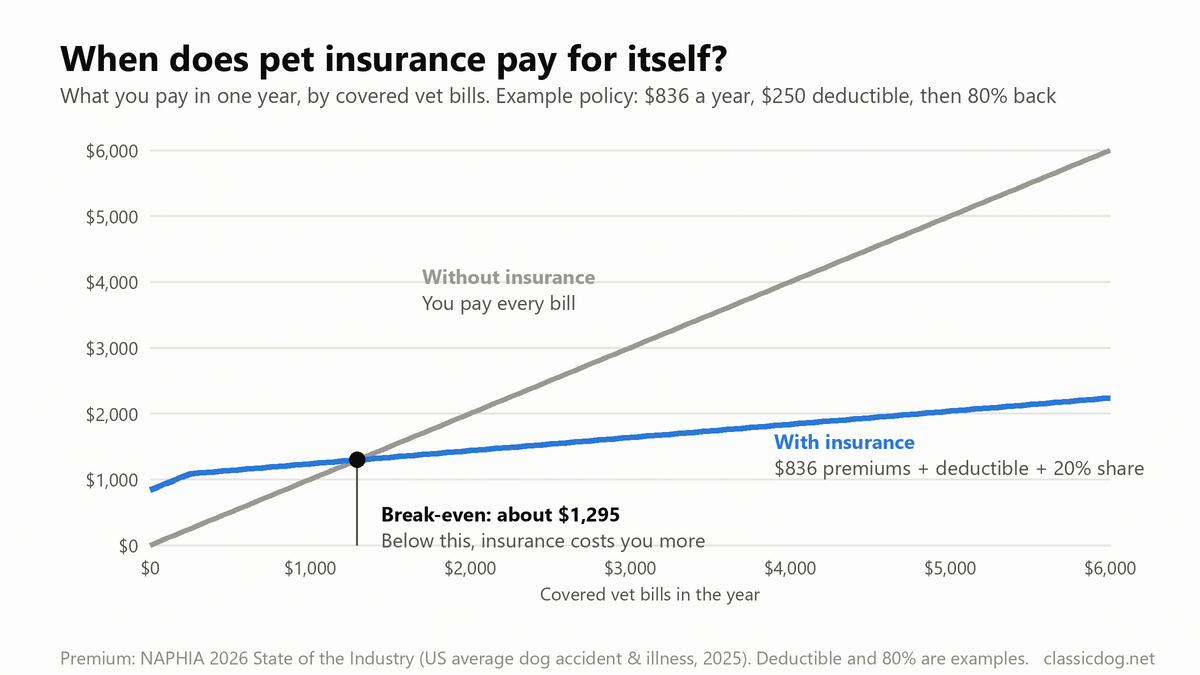
For a policy priced at the US average, with a $250 deductible and 80% reimbursement, insurance comes out ahead in a year when covered vet bills pass about $1,300. Below that, you’d have been better off paying the vet yourself. Above it, the policy saves money, and in a really bad year it can save thousands. Your own break-even depends on your quote, which is why the calculator asks for it.
That figure comes from the industry’s own average price. The North American Pet Health Insurance Association (NAPHIA) reported in its June 2026 report that the average accident and illness premium for a dog in the US was $836 a year in 2025, about $70 a month. That’s up 11.5% from $749 in 2024. Run $836 through the calculator with a $250 deductible and 80% reimbursement, and the break-even point is about $1,295 of covered bills.
I’m not a vet or an insurance agent, and I don’t own a dog. I’m not selling any policy, and nothing on this page is a recommendation to buy or skip one. It’s arithmetic, done in the open, so you can check it.
How the calculator works
It models one year. The cost with insurance is your yearly premium plus the part of each bill you still pay: the deductible, then your share above it. If you pick 80% reimbursement, your share is 20%. If the policy has a yearly payout limit, the insurer stops paying once it’s reached, and you pay the rest.
The break-even number is where the two costs meet. If the deductible comes off first, the formula is: deductible + (yearly premium ÷ reimbursement rate). For the example policy, that’s $250 + ($836 ÷ 0.8) = $250 + $1,045 = $1,295.
Not every policy works that way. Some work out the percentage on the whole bill first and then take off the deductible, which pays a little less. On a $3,000 bill with a $250 deductible and 80% back, the first method pays $2,200 and the second pays $2,150. The calculator lets you pick either. Some insurers also charge a deductible per condition instead of once a year, and the calculator doesn’t model that, so read how your policy words it.
A worked example
Say a dog’s policy costs $70 a month ($840 a year) with a $250 yearly deductible taken off first and 80% back. In a year with $3,000 of covered bills, the insurer pays 80% of $2,750, which is $2,200. You pay the $250 deductible, plus $550 (your 20%), plus the $840 in premiums. That’s $1,640, compared with $3,000 if you had no policy. You save $1,360.
Now take a quiet year with no claims. You’ve paid $840 and got nothing back. That’s not a failure of the policy; it’s what insurance is. Here’s the same policy across a range of years:
| Covered vet bills in the year | Insurer pays | You pay with insurance | You pay without | Insurance |
|---|---|---|---|---|
| $0 | $0 | $840 | $0 | costs $840 more |
| $500 | $200 | $1,140 | $500 | costs $640 more |
| $1,000 | $600 | $1,240 | $1,000 | costs $240 more |
| $1,300 | $840 | $1,300 | $1,300 | breaks even |
| $2,500 | $1,800 | $1,540 | $2,500 | saves $960 |
| $3,000 | $2,200 | $1,640 | $3,000 | saves $1,360 |
| $5,000 | $3,800 | $2,040 | $5,000 | saves $2,960 |
| $10,000 | $7,800 | $3,040 | $10,000 | saves $6,960 |
What the industry numbers say
NAPHIA’s 2025 report gives a useful view from the other side. In 2024, the latest year I found claims figures for, US pet insurers took in $4.74 billion in premiums and paid about $3.07 billion in claims. That works out to roughly 65 cents paid back for each premium dollar, across all policyholders, cats included. These are two industry-wide yearly totals, not a payout rate for any one policy, but the gap is wide. Across the industry, policyholders as a group pay in more than they get back. The people who come out ahead are the ones whose pets have an expensive year.
The 2026 report says about 5.99% of US dogs were insured at the end of 2025. So most dog owners pay the vet directly.
Vet prices matter here too. The Bureau of Labor Statistics price index for veterinarian services rose about 69% between September 2016 and September 2026. Prices overall rose about 40% in the same decade. A big bill today is bigger than the same treatment was ten years ago, and that’s part of why people look at insurance in the first place.
What the calculator can’t see
The math is the easy part. The policy wording is where the surprises are. The American Veterinary Medical Association suggests checking these before you buy, and I’d add them to the list of things the calculator ignores:
- Pre-existing conditions. Find out how the company defines them. A problem your dog had before the policy started may never be covered.
- What’s excluded. Routine and wellness care, dental care and some conditions may be left out or sold as add-ons.
- Price rises. Ask how the premium changes as your dog gets older, and whether making a claim raises it.
- Breed limits. Some companies won’t cover certain breeds they see as high risk.
- Paying up front. Most plans reimburse you after you’ve paid the vet, so you still need the cash on the day.
That last point is easy to miss. If a $4,000 emergency would be hard to pay even for a few weeks, ask your vet about payment options now, before you need them. The AVMA makes the same suggestion.
So, is it worth it for you?
I’d think about it this way. Insurance makes the most sense when one large bill would hurt you badly, and when you’d want to say yes to treatment without checking your bank balance first. It makes less sense if you could absorb a few thousand dollars without trouble. Then putting the premium into a savings account each month, and leaving it alone, may cost you less over the dog’s life.
Buying while your dog is young and healthy matters, because of how pre-existing conditions work. The ASPCA suggests considering insurance while your pet is healthy and reading the fine print. If you’re planning a budget, the dog cost calculator includes insurance as one line you can switch on or off. The lifespan guide helps if you want to think in years, not months.
One last tip: when you compare quotes, set them to the same deductible, reimbursement rate and limit. Otherwise you’re comparing different products, and the cheapest monthly price can easily be the worst deal.
Sources
- North American Pet Health Insurance Association. State of the Industry Report 2026 Highlights (2025 data). June 2026. naphia.org (PDF)
- North American Pet Health Insurance Association. North American Pet Health Insurance Industry Market Reaches $5.2B in Written Premium (2025 State of the Industry Report highlights). April 22, 2025. naphia.org
- American Veterinary Medical Association. Do you need pet insurance? avma.org
- U.S. Bureau of Labor Statistics. Consumer Price Index, veterinarian services, U.S. city average (series CUUR0000SS62054). data.bls.gov
- U.S. Bureau of Labor Statistics. Consumer Price Index, all items, U.S. city average (series CUUR0000SA0). data.bls.gov
- ASPCA. Cutting Pet Care Costs (2021 update). aspca.org
Last reviewed: November 14, 2026. Written by Santosh Mahajan. This calculator is a simple model and isn’t financial, insurance or veterinary advice. Always read a policy’s terms before you buy. See the Disclaimer and the Editorial Policy.