“How big is he going to get?” is the question every puppy owner asks, usually while looking at paws that seem far too large for the rest of the dog. This estimator gives you a number based on real growth data from US puppies, not a guess from a breed chart. Enter your puppy’s weight, age and sex, and it works out where they’re likely to end up.
Puppy adult weight estimator
An estimate only, based on the WALTHAM/Banfield growth standards published by Salt et al. (2017) from more than 6 million US puppies (sources below). It does not cover giant breeds over 88 lb, puppies under 12 weeks, or puppies who are ill or overweight. Not veterinary advice.
Where the numbers come from
The estimator is built on growth standards published in 2017 by Carina Salt and colleagues in the journal PLoS ONE. The team, from the WALTHAM pet nutrition center and Banfield Pet Hospital, started with weight records from more than 6 million young dogs seen at Banfield’s network of about 900 US vet hospitals. They kept only dogs that were healthy and stayed at an ideal body condition through their first three years, then built growth charts from 12 weeks to 2 years old.
Their main finding was useful for anyone with a mixed-breed puppy: you don’t need a separate chart for every breed. Five size groups described growth well for breeds up to about 88 lb (40 kg), with separate curves for males and females. AAHA’s 2021 nutrition guidelines list these same WALTHAM puppy growth charts as a resource for vets.
The paper publishes the charts as images, not tables. So I read the curves off the published figures at 24 ages for each size group and sex, checked them against the gridlines, and built the calculator from those numbers. They should be within a few percent of the original curves.
How the estimate works, with an example
Growth charts have percentile lines. If a puppy is on the 25th percentile line, a quarter of healthy puppies of the same size group, sex and age weigh less. A 2020 follow-up study by the same group checked how well puppies stick to their line. Among healthy dogs, fewer than 5% crossed more than two percentile lines while growing. Puppies that later became overweight were different: 68% of them crossed two or more lines upward.
So the calculator finds which percentile your puppy is on today, then follows that line out to 2 years old. Say you have a male Labrador puppy who weighs 25 lb at 4 months (about 17 weeks). In the “very large” group, the median male at that age weighs about 34 lb, so 25 lb puts him near the 9th percentile. Following the 9th percentile line to 2 years gives about 64 lb. If he drifts one line up or down along the way, he’d end up somewhere between 57 and 70 lb.
If you choose “Not sure”, the calculator tries all five size groups and picks the one where your puppy’s predicted adult weight actually falls inside that group’s range. For the same 25 lb puppy, that’s the “large” group, with an estimate of about 56 lb. The two answers differ because the size group changes which line the puppy is on, which is why picking the group yourself is better when you know the breed.
How much of their adult weight puppies have at each age
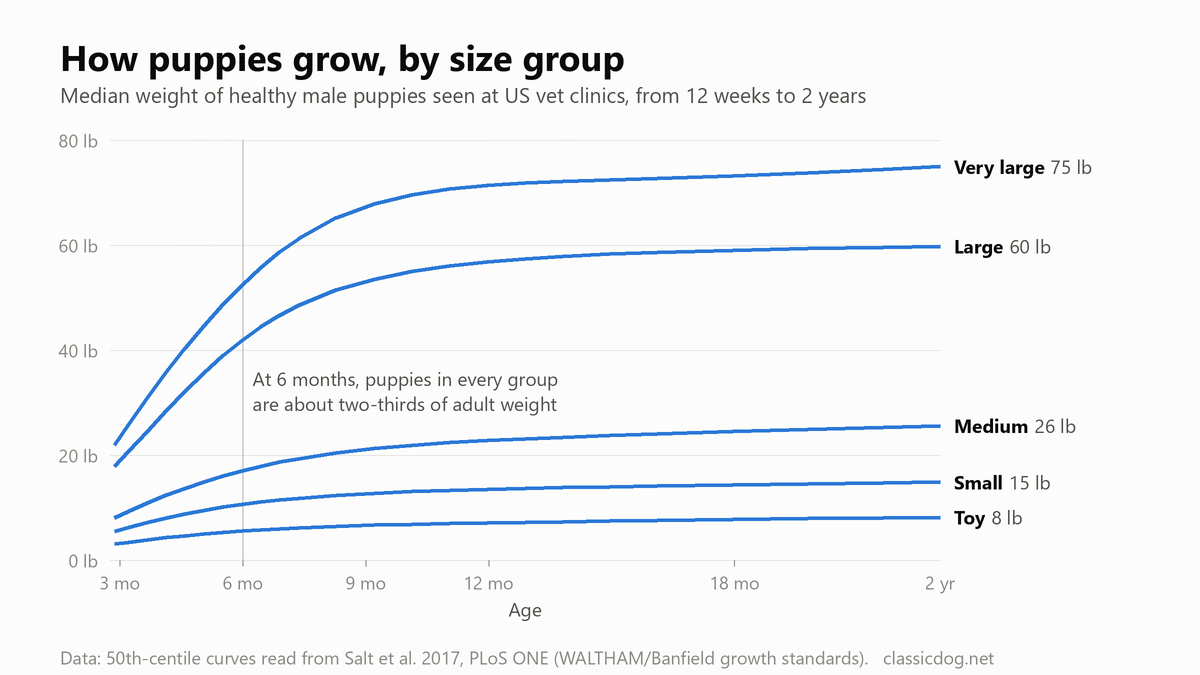
Here’s what the median curves look like when you divide each age by the weight at 2 years. Males and females are averaged, since they were within a few points of each other.
| Size group (adult weight) | 3 months | 4 months | 6 months | 9 months | 12 months | 18 months |
|---|---|---|---|---|---|---|
| Toy (under 14 lb) | 40% | 52% | 68% | 80% | 87% | 95% |
| Small (14–20 lb) | 40% | 52% | 70% | 84% | 90% | 96% |
| Medium (20–33 lb) | 34% | 47% | 66% | 80% | 88% | 96% |
| Large (33–66 lb) | 33% | 46% | 70% | 88% | 94% | 98% |
| Very large (66–88 lb) | 32% | 46% | 70% | 88% | 94% | 98% |
Two things surprised me here. First, every group is close to two-thirds of adult weight at 6 months, and roughly half at 4 months. That’s why the old trick of doubling a puppy’s 4-month weight isn’t a bad rough guess for an average puppy. Second, the toy and small curves keep creeping up slowly through the second year, while the large groups flatten out sooner. The paper’s introduction cites earlier research saying very small dogs reach maturity at 8 to 12 months and larger breeds can take up to 24 months, so part of that late creep in small dogs is probably a little adult weight gain rather than growth.
What it can’t tell you
Giant breeds aren’t covered. The size groups stop at about 88 lb. Great Danes, Mastiffs and similar breeds grow for longer and to a size these charts don’t include. AAHA’s guidelines say the same thing: growth charts aren’t available for giant-breed dogs.
Puppies under 12 weeks aren’t covered either. The charts start at 12 weeks, and very young puppies change fast.
“Adult weight” here means weight at 2 years. That’s where the charts end. Your dog’s weight later in life depends a lot on how much they eat and how active they are.
It assumes a healthy puppy at a healthy weight. The charts were built only from dogs that stayed at ideal body condition. If your puppy is already chubby, the estimate will come out too high, because it reads extra fat as extra growth. An underweight or sick puppy will get an estimate that’s too low.
Mixed breeds are a best guess. If your puppy is a cross between a small and a large breed, the honest answer is that nobody can be sure. Use the range, not just the middle number.
What to do with the number
The most practical use is deciding what to feed. AAHA’s 2021 guidelines advise a diet made for large-breed growth when a puppy is expected to weigh 70 lb or more as an adult, and keeping large-breed puppies lean to reduce the risk of joint and bone problems. The Merck Veterinary Manual explains why: in fast-growing large-breed puppies, too much calcium is linked to more severe osteochondrosis, a disease of developing joints. So please don’t add calcium supplements to a complete puppy food, and don’t try to make a big puppy grow faster.
The second use is spotting problems early. AAHA’s 2014 weight management guidelines suggest checking a puppy’s body condition every two weeks. If you weigh your puppy every couple of weeks and run the estimator each time, the answer should stay fairly steady. If the estimate keeps climbing, your puppy may be gaining fat rather than growing, and it’s worth asking your vet to check body condition. If it keeps dropping, that’s worth a vet visit too.
Once you have an idea of adult size, the dog food calculator can help with daily calories (use the puppy setting while they’re growing), and the dog cost calculator will show you how much a dog of that size is likely to cost each year.
Sources
- Salt C, Morris PJ, German AJ, Wilson D, Lund EM, Cole TJ, Butterwick RF. Growth standard charts for monitoring bodyweight in dogs of different sizes. PLoS ONE. 2017;12(9):e0182064. journals.plos.org
- Salt C, Morris PJ, Butterwick RF, Lund EM, Cole TJ, German AJ. Comparison of growth patterns in healthy dogs and dogs in abnormal body condition using growth standards. PLoS ONE. 2020;15(9):e0238521. journals.plos.org
- Cline MG, et al. 2021 AAHA Nutrition and Weight Management Guidelines for Dogs and Cats: Prevention of Obesity, and Weight Reduction in the Obese Pet. aaha.org
- Brooks D, et al. 2014 AAHA Weight Management Guidelines for Dogs and Cats. Journal of the American Animal Hospital Association. 2014;50(1):1–11. aaha.org (PDF)
- Merck Veterinary Manual. Nutritional Requirements of Small Animals. merckvetmanual.com
Last reviewed: October 17, 2026. Written by Santosh Mahajan. This estimator gives a rough guide and isn’t veterinary advice. If you’re worried about how your puppy is growing, please talk to your vet. See the Disclaimer and the Editorial Policy.