
I own no dog, so I can’t tell you what a Collie “should” look like from experience. What I can do is compare two written descriptions: how breeders described a few breeds in the first years of the 1900s, and how the American Kennel Club (AKC) describes them now. The old books are free on Project Gutenberg, and the AKC publishes every breed standard as a PDF. I read both, and the differences are smaller than I expected in some breeds and bigger in others.
One caution before the numbers. Leighton’s book describes British dogs and British breed standards, while the AKC standards are American. So every comparison below is a difference between two documents written in different countries as well as different eras, not proof of how the dogs themselves changed. Some figures also measure different things: a few old figures are averages, while most AKC figures are minimums or ranges. I’ve labeled those where they appear.
This is a history page, not breed advice. I’m not a vet, and I haven’t tried to judge whether any breed’s look is healthy. I only compare what the documents say.
The two old books
Dogs and All About Them by Robert Leighton is a British guide to breeds. Its preface mentions dog licences taken out in 1909, so it dates from around 1910. I use it for the Bulldog, Collie, Mastiff, Great Dane and St. Bernard. The Boston Terrier and All About It by Edward Axtell was copyrighted in 1910 and is about a breed that was then only a few decades old. Both are in the public domain in the US. For today I used the official AKC standards, which carry approval dates from 1977 (Collie) to 2019 (Great Dane).
Size: some breeds hardly moved
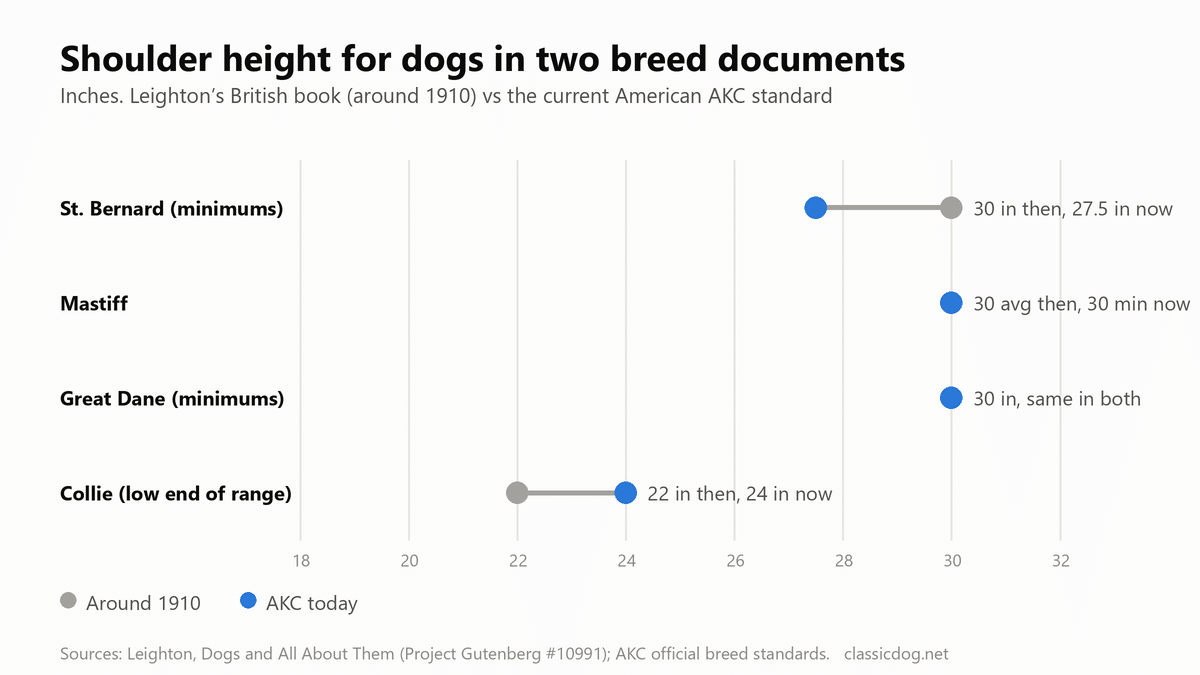
The Great Dane is the clearest example. Leighton’s standard says an adult dog should be at least 30 inches at the shoulder and a bitch 28 inches. The current AKC standard says the male shall not be less than 30 inches and the female not less than 28. The Mastiff looks close too, but the numbers aren’t the same kind. Leighton calls thirty inches a fair average height for dogs, with bitches somewhat less. The AKC’s Mastiff standard now gives 30 inches as a minimum for dogs and 27½ for bitches. An average of 30 and a minimum of 30 describe different things, so all I can say is that both documents put 30 inches at the center of attention.
The Bulldog hasn’t changed much in weight, either. Leighton writes that “the most desirable weight for a Bulldog is about 50 lbs.” The AKC says about 50 pounds for mature dogs and about 40 for bitches. For comparison, Leighton says the old bull-baiting dogs of earlier centuries averaged about 16 inches and about 45 lbs.
| Breed | Around 1910, British (Leighton) / American (Axtell) | AKC standard today (American) |
|---|---|---|
| Bulldog | Desirable weight about 50 lbs | About 50 lb (dogs), about 40 lb (bitches) |
| Collie | Dogs 22 to 24 in, 45 to 65 lbs. Bitches 20 to 22 in, 40 to 55 lbs | Dogs 24 to 26 in, 60 to 75 lb. Bitches 22 to 24 in, 50 to 65 lb |
| Boston Terrier | Weight classes 12 to 17, 17 to 22, 22 to 28 lb | Under 15, 15 to under 20, 20 to 25 lb |
| Great Dane | Minimum 30 in (dog), 28 in (bitch); weight at least 120 and 100 lbs | Minimum 30 in (male), 28 in (female); no weight given |
| Mastiff | Average about 30 in for dogs; weight over 160 lb | Minimum 30 in (dogs), 27½ in (bitches) |
| St. Bernard | Minimum 30 in (dog), 27 in (bitch) | Minimum 27½ in (dog), 25½ in (bitch) |
Size: Collies and Boston Terriers did change
The Collie got bigger on paper. Leighton gives 22 to 24 inches and 45 to 65 lbs for dogs, and 20 to 22 inches and 40 to 55 lbs for bitches. The current AKC standard says dogs are 24 to 26 inches and 60 to 75 pounds, and bitches 22 to 24 inches and 50 to 65 pounds. Every height endpoint is 2 inches higher. On weight, the minimum for dogs is 15 lb higher, and the other three weight endpoints are each 10 lb higher.
The Boston Terrier went the other way. Axtell prints the early standard’s weight classes: lightweight 12 to 17 pounds, middleweight 17 to 22 and heavyweight 22 to 28, with an additional toy class under 12. He says that when he joined the Boston Terrier Club in 1895 there were only two classes, 15 to 23 and 23 to 30. The AKC’s standard today lists under 15 pounds, 15 and under 20, and 20 and not to exceed 25. The heaviest dogs allowed are lighter than they were.
The St. Bernard is the surprise. Leighton’s standard says a dog should be at least 30 inches and a bitch 27. The AKC now gives 27½ inches minimum for dogs and 25½ for bitches. Leighton also complains that for the previous twenty-five years St. Bernards in his country had been bred taller and heavier than the famous champions of earlier days, and says it was done by forcing puppies and fattening them, to the point of hurting their constitution. I can’t say from these two documents whether that’s why the minimum is lower now. I only know that it is lower.
What the writers cared about
Both old books describe a dog’s character as part of its standard. Leighton writes that no one point of a Bulldog should be in excess of the others “so as to destroy the impression of determination, strength, and activity.” He says the head “cannot be too large so long as it is square.” The AKC’s current Bulldog standard still starts with a general appearance of stability, vigor and strength, and asks for a “massive short-faced head,” but it also says no feature should be so prominent that the animal appears deformed or ill-proportioned. It adds that the disposition should be equable and kind, resolute and courageous, and not vicious or aggressive. Reading the two side by side, the modern version is more worried about exaggeration.
The Boston Terrier gives a cleaner example. Axtell describes the breed as a cross of the English Bulldog and the bull terrier, and says it was first called the Boston bull or round-headed bull and terrier before the AKC recognized it in 1893 as the Boston Terrier. He prints a standard that disqualifies a docked tail, and the AKC’s current standard still does: “Disqualify – Docked tail.” The standard now also says the tail is set on low, short, fine and tapering, straight or screw.
Why the numbers moved
I don’t know, and the sources don’t say, so I won’t guess in detail. What I can say is that these standards were written by breed clubs, not by vets, and clubs revise them. The Collie standard I read was approved in 1977, the Bulldog’s in 2016 and the Great Dane’s in 2018 with an effective date of January 1, 2019. A “100 years ago” comparison is really a comparison of when each club last agreed on a number.
It also means a breed standard describes an ideal, not the dog sitting next to you. If you want a number for your own dog, ask your vet. To judge whether your own dog is at a healthy weight, the body condition score guide shows how vets check by hand and eye, and the 1900s care advice page looks at the same era’s feeding and medicine advice.
Sources
- Leighton R. Dogs and All About Them. Project Gutenberg eBook #10991. gutenberg.org
- Axtell E. The Boston Terrier and All About It (1910). Project Gutenberg eBook #18033. gutenberg.org
- American Kennel Club. Official Standard of the Bulldog (effective August 31, 2016). akc.org (PDF)
- American Kennel Club. Official Standard of the Collie (approved May 10, 1977). akc.org (PDF)
- American Kennel Club. Official Standard of the Boston Terrier (effective March 30, 2011). akc.org (PDF)
- American Kennel Club. Official Standard of the Great Dane (effective January 1, 2019). akc.org (PDF)
- American Kennel Club. Official Standard of the Mastiff (effective December 31, 1991). akc.org (PDF)
- American Kennel Club. Official Standard of the Saint Bernard (effective May 31, 1998). akc.org (PDF)
Last reviewed: November 12, 2026. Written by Santosh Mahajan. This is a history piece comparing published documents. It isn’t breed or medical advice, and I’m not a vet. See the Disclaimer and the Editorial Policy.