Thinking about getting a dog, or just wondering where the money goes? This calculator starts from the ASPCA’s published cost estimates and updates them to September 2026 prices using official US inflation data. Every figure is editable, so you can swap in what you actually pay.
Dog cost calculator
Every amount is pre-filled with the ASPCA’s 2021 estimate, adjusted to September 2026 prices with US inflation data. That is a price-adjusted estimate, not a survey of what owners pay today. Change anything that doesn’t fit your dog or where you live.
Yearly costs (every year)
One-time costs (first year only)
Extras the ASPCA adds in year one (set to 0 to skip)
Estimates in September 2026 US dollars. Base figures: ASPCA (2021), adjusted with US Bureau of Labor Statistics price indexes (September 2026 was the latest month available when this was calculated on October 14, 2026). Each item is rounded to the nearest dollar before the totals are added up. Doesn’t include emergency vet care. Sources below.
The short answer
With the calculator’s default figures, a medium-sized dog costs about $1,775 a year to keep, or roughly $148 a month. The first year is much more expensive, at about $4,290, because of one-time costs like spaying or neutering, first vaccines, a crate and training classes. That’s before any purchase price or adoption fee.
Those are the ASPCA’s 2021 estimates adjusted to September 2026 prices, not a survey of what owners pay today. An inflation adjustment shows how prices in each category have moved, but it can’t tell you, for example, what a pet insurance policy costs now. Vet fees in a big city can be far higher than in a small town, and a long-haired dog that needs regular grooming costs more than a short-coated one. Treat the defaults as a starting point and change anything you know is different for you.
Where the numbers come from
The ASPCA publishes a breakdown of what it costs to keep a dog. Its most recent update, from 2021, put a dog’s yearly costs at $1,391 and the first year at $3,221, including $1,030 of one-time costs plus professional grooming and a dental cleaning.
A lot has changed since 2021, so I didn’t want to use those numbers as they were. The US Bureau of Labor Statistics tracks prices for pet food, vet care, pet services and pet supplies separately in the Consumer Price Index. I compared the average for each category in 2021 with September 2026, the latest month available when I did the calculation on October 14, 2026, and adjusted each ASPCA item by the category it belongs to. Each item is rounded to the nearest dollar, and the totals are the sum of those rounded items:
| Item | ASPCA 2021 | Price index used | Change | Sept 2026 estimate |
|---|---|---|---|---|
| Food | $300 | Pet food and treats | +24.5% | $373 |
| Treats | $60 | Pet food and treats | +24.5% | $75 |
| Vet check-ups and vaccines | $225 | Vet services | +44.6% | $325 |
| Flea, tick and heartworm meds | $185 | Vet services | +44.6% | $267 |
| Pet insurance | $516 | All prices | +24.3% | $642 |
| Toys | $37 | Pet supplies | +12.8% | $42 |
| Grooming supplies | $28 | Pet supplies | +12.8% | $32 |
| License | $15 | All prices | +24.3% | $19 |
| Yearly total | $1,391 | $1,775 | ||
| One-time costs (8 items) | $1,030 | Mixed | $1,399 | |
| Professional grooming | $300 | Pet services | +32.4% | $397 |
| Dental cleaning | $500 | Vet services | +44.6% | $723 |
| First-year total | $3,221 | $4,294 |
Pet insurance and dog licenses don’t have their own price index, so for those I used the overall inflation rate. That makes the insurance figure the roughest of all: insurance premiums depend on the insurer, the plan, and your dog’s age, breed and location. The full method, with the index values I used, is in the sources at the end.
Two things to know about the first-year total. The ASPCA treats professional grooming and a dental cleaning as first-year extras, so they are in the first-year figure but not in the yearly one. If your dog needs either every year, add it to a yearly box. And the ASPCA lists first vaccines and vet visits separately from routine yearly check-ups, so year one may count some vet costs twice. You can lower either box if that’s the case for you.
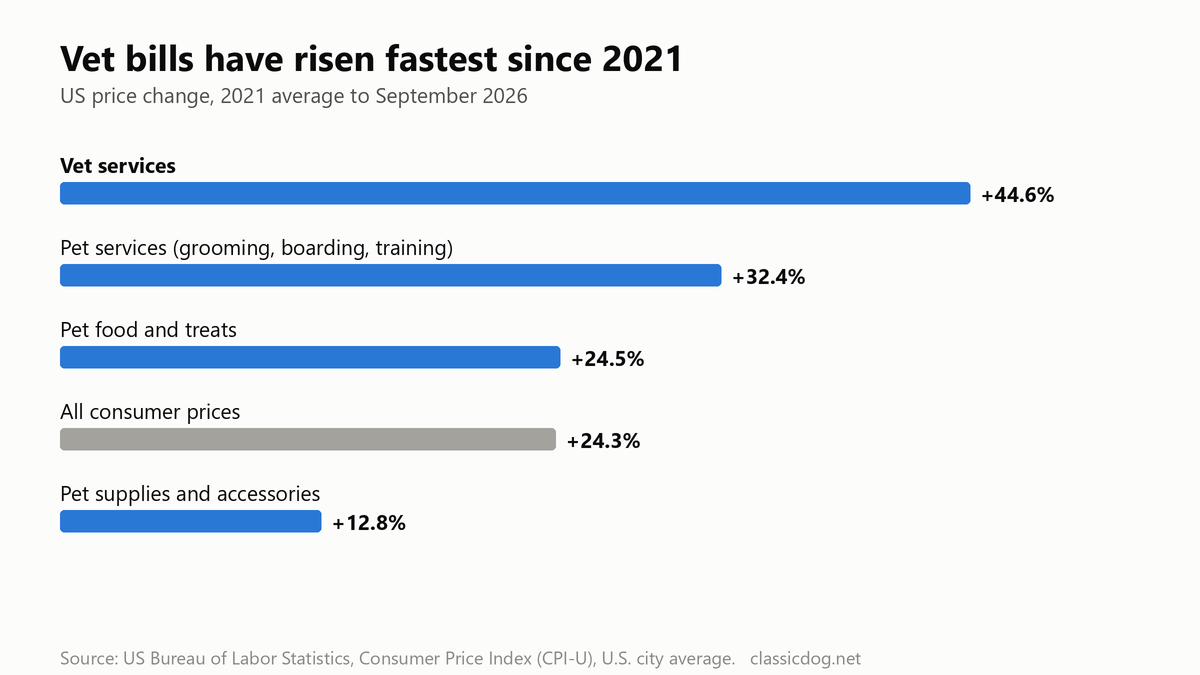
The most striking result is how much faster vet care has gone up than everything else. Vet prices rose about 45% over the period, while prices in general rose about 24%. Pet supplies like leashes and crates went up only about 13%. If you’re budgeting for a dog, the vet bills are where the surprises are.
What the calculator doesn’t include
The ASPCA’s figures cover the everyday basics. They don’t include:
- Emergency vet care or treatment for serious illness. This is the cost that can catch owners out, and the main thing pet insurance is designed to cover.
- Dog walkers, daycare or a pet sitter, if you work long hours.
- Pet deposits or monthly pet rent, if you rent your home.
- Replacing things your dog chews, and the occasional new bed or bowl.
If any of these apply to you, add a rough yearly amount to one of the boxes, such as toys, to keep the total honest.
Why your dog’s size matters
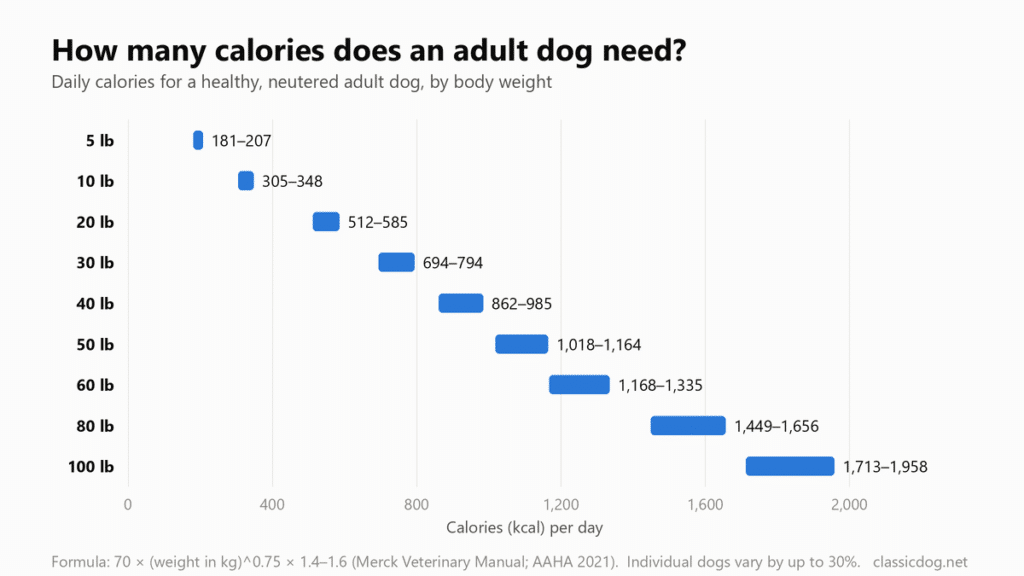
Size changes the bill in two ways. First, food: a 70-pound dog eats a lot more than a 15-pound one. The ASPCA’s food figure is a single average, so if you know what your dog eats, use the food cost box in the calculator. It works out your dog’s daily calories with the same vet formula as our dog food calculator, then uses your bag’s price, size and calorie content to estimate a yearly food bill.
Second, lifespan. A large study of dogs seen at Banfield vet hospitals in the US, published in 2019 by Urfer and colleagues, estimated median lifespans of about 15 years for small dogs, 13.9 for medium, 13.4 for large and 11.1 for giant dogs. The calculator uses these to estimate a lifetime cost. Its weight bands are my approximation of the study’s size groups, and other studies using different dogs and methods have come up with different figures, so treat the lifespan as tied to this one source. Changing the size changes only the lifespan used for the lifetime total, not the food or other amounts. In today’s money, a medium dog comes to roughly $27,000 over its life at the default figures. That number isn’t meant to scare anyone off. It’s a useful reminder that a dog is a long commitment, and it’s easier to plan for when you can see it.
Ways to keep costs down
The ASPCA suggests a few ways to save money without cutting corners on care. These are the ones I think make the biggest difference:
- Don’t skip the yearly check-up. Catching a problem early is almost always cheaper than treating it late.
- Ask about your dog’s vaccine schedule. Some vaccines are essential or legally required, others depend on your dog’s lifestyle. Your vet can tell you which your dog needs.
- Look for low-cost spay and neuter programs. Many local shelters run them, and the ASPCA has a search tool for finding one.
- Brush your dog’s teeth. Dental disease can lead to expensive treatment, and a home routine helps keep teeth and gums healthy. Ask your vet which products to use, and never use human toothpaste.
- Keep up with flea, tick and parasite prevention. Treating an infestation costs more than preventing one.
- Groom at home where you can. Regular brushing and nail trims cut down on professional grooming visits.
- Don’t overfeed. Extra weight leads to health problems, and measuring food properly saves money on the food itself.
On insurance, the ASPCA’s advice is to consider it if an emergency vet bill would be a real financial strain, and to read the policy details carefully, because plans vary a lot. If you skip insurance, set the insurance box to zero and think about putting a similar amount aside each month instead.
Sources
- ASPCA. Cutting Pet Care Costs (2021 cost estimates). aspca.org
- US Bureau of Labor Statistics. Consumer Price Index for All Urban Consumers (CPI-U), U.S. city average, not seasonally adjusted: veterinarian services (CUUR0000SS62054), pet services (CUUR0000SS62053), pet food and treats (CUUR0000SS61031), purchase of pets, pet supplies and accessories (CUUR0000SS61032), all items (CUUR0000SA0). Each ASPCA item was multiplied by its category’s September 2026 index divided by its 2021 annual average (2021 average and September 2026: veterinarian services 288.769 and 417.438; pet services 210.525 and 278.694; pet food and treats 156.225 and 194.440; pet supplies 117.157 and 132.164; all items 270.970 and 336.940). Data retrieved 14 October 2026, when September 2026 was the latest month published. Series pages: veterinarian services, pet services, pet food and treats, pet supplies, all items.
- Urfer SR, et al. Risk Factors Associated with Lifespan in Pet Dogs Evaluated in Primary Care Veterinary Hospitals. Journal of the American Animal Hospital Association. 2019;55(3):130–137. PubMed
Last reviewed: November 12, 2026. Written by Santosh Mahajan. Prices are the ASPCA’s 2021 estimates adjusted to September 2026 US dollars, and your own costs will vary. See the Disclaimer and the Editorial Policy.