Put in your dog’s age and size. You’ll get a human-age equivalent from a 2020 study that compared aging in dogs and people at the DNA level, plus your dog’s life stage according to vet guidelines. Below the calculator I explain how it works, where it falls short, and what the number is actually useful for.
Dog age calculator
Estimate only. Based on a 2020 study of Labrador retrievers and AVMA/AAHA life-stage guidance (sources below). Not veterinary advice.
Why “multiply by 7” doesn’t work
The seven-year rule is easy to remember, and it’s wrong at both ends of a dog’s life. A one-year-old dog is physically able to have puppies. No seven-year-old child is. The American Veterinary Medical Association says plainly that dogs don’t age at seven human years per dog year.
What actually happens is that dogs rush through their first couple of years and then slow down a lot. A straight-line rule can’t show that. A curve can.
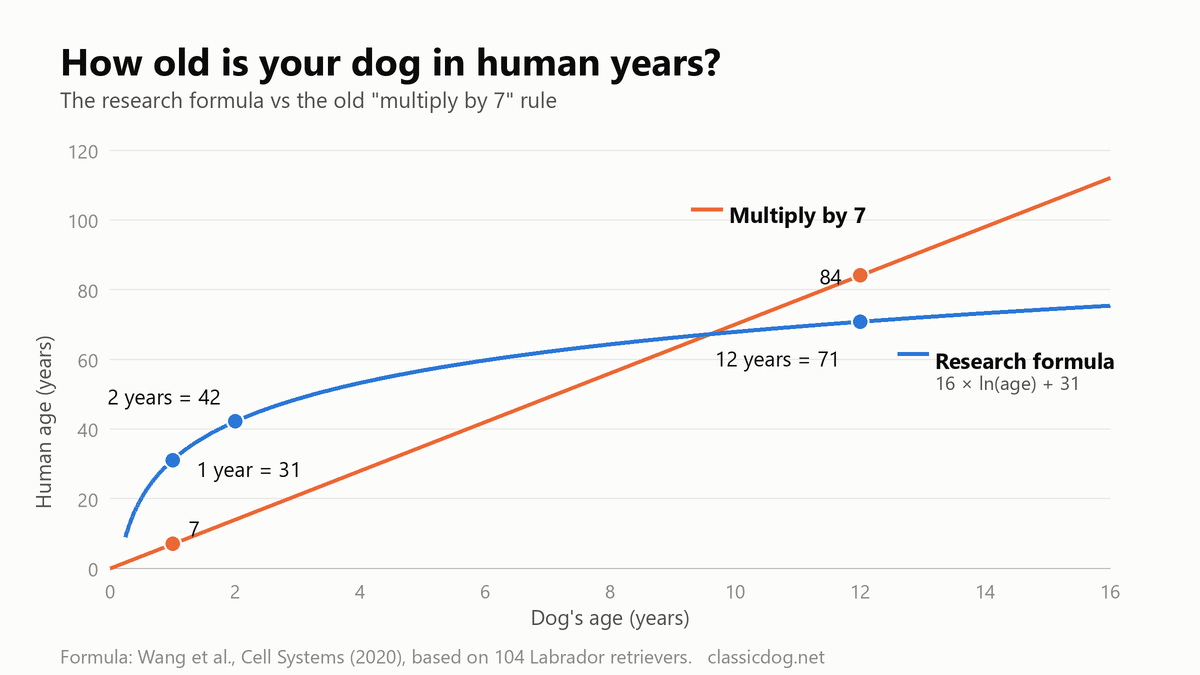
The blue curve climbs steeply at first: a 1-year-old dog lands at about 31 in human terms, a 2-year-old at about 42. After that it flattens. The orange “times 7” line does the opposite, starting too low and ending far too high. The two lines cross at around 9 to 10 dog years, which is the only age where the old rule is roughly right.
How this calculator works
In 2020, a team led by researchers at the University of California San Diego published a study in the journal Cell Systems. They looked at DNA methylation, which is a set of chemical tags on DNA that build up in a fairly predictable way as any mammal gets older. They measured it in 104 Labrador retrievers, from puppies a few weeks old to 16-year-old dogs, and matched each dog to people with similar patterns.
The relationship they found is a logarithmic curve:
human age = 16 × ln(dog age) + 31
“ln” is the natural logarithm, the button marked ln on any scientific calculator. For a 3-year-old dog, ln(3) is 1.0986. Multiply by 16 and you get 17.6. Add 31 and you get 48.6, so about 49 human years. That’s exactly what the calculator does, rounded to the nearest year.
The researchers checked the formula against milestones that both species go through. An 8-week-old puppy came out at roughly 9 months in human terms, the age when both puppies and babies are getting their first teeth. At the other end, 12 years, a typical Labrador lifespan, came out at about 70, close to average human life expectancy worldwide.
Here’s how the numbers compare across a dog’s life:
| Dog’s age | Human age, research formula (years) | Human age, “times 7” rule (years) |
|---|---|---|
| 6 months | 20 | 3.5 |
| 1 year | 31 | 7 |
| 2 years | 42 | 14 |
| 3 years | 49 | 21 |
| 4 years | 53 | 28 |
| 5 years | 57 | 35 |
| 6 years | 60 | 42 |
| 7 years | 62 | 49 |
| 8 years | 64 | 56 |
| 9 years | 66 | 63 |
| 10 years | 68 | 70 |
| 11 years | 69 | 77 |
| 12 years | 71 | 84 |
| 13 years | 72 | 91 |
| 14 years | 73 | 98 |
| 15 years | 74 | 105 |
| 16 years | 75 | 112 |
Where the formula falls short
I’d rather you know the limits than trust the number too much.
First, every dog in the study was a Labrador. The authors say themselves that breeds with very different lifespans could give different curves. A Chihuahua and a Great Dane almost certainly don’t age along the same line, but nobody has yet published a breed-by-breed version based on the same method.
Second, size matters a lot, and the formula ignores it. I thought about adding a size “correction” to the human-age number, but I couldn’t find one in the research that I’d trust, and making one up would defeat the point of using a study-based formula. So the calculator uses size only for the life stage part, where there is solid vet guidance, and leaves the human-age number exactly as the study gives it.
Third, the formula breaks down for very young puppies. The logarithm of a tiny number is a large negative number, so below about 2 months the result stops making sense. The calculator won’t give an answer before that age.
When is a dog a senior?
This is the question the human-age number is usually standing in for, and vets answer it differently. The AVMA suggests treating a dog as senior when it reaches the last 25 percent of the expected lifespan for its breed. Because big dogs live shorter lives, that point comes earlier for them. Using American Kennel Club data, the AVMA gives these rough ages:
| Size | Adult weight | Usually senior from |
|---|---|---|
| Small or toy | under 20 lb (about 9 kg) | 8 to 11 years |
| Medium | 20 to 50 lb (about 9 to 23 kg) | 8 to 10 years |
| Large | 50 to 90 lb (about 23 to 41 kg) | 8 to 9 years |
| Giant | over 90 lb (about 41 kg) | 6 to 7 years |
The American Animal Hospital Association (AAHA) takes a similar view in its 2019 life stage guidelines for dogs. It splits a dog’s life into puppy, young adult, mature adult, senior and end of life. Puppyhood lasts until rapid growth stops, around 6 to 9 months depending on size. Young adulthood runs until the dog is fully mature physically and socially, at about 3 to 4 years. After that the guidelines deliberately avoid fixed ages, because dogs vary too much.
Interestingly, the AAHA task force chose not to convert dog ages into human years at all. They found it more practical to define life stages by age and the dog’s actual condition. That’s why the calculator gives you both. The human-age figure is fun and easy to picture. The life stage is the part that changes how your dog should be looked after.
Why size changes everything
One of the largest studies on this, published in the Journal of the American Animal Hospital Association in 2019, looked at the records of dogs seen at 787 US veterinary hospitals. The median lifespans it estimated by size were about 15 years for small dogs, 13.9 for medium, 13.4 for large and 11.1 for giant dogs.
That’s a gap of almost four years between the smallest and the biggest dogs. It’s the reason a 7-year-old Great Dane and a 7-year-old Shih Tzu are at very different points in life, even though the same formula gives them the same human age.
What to do with the result
Honestly, the human-age number is mostly a conversation starter. The life stage is the useful bit.
If the calculator says your dog is a puppy or young adult, the main job is the routine your vet sets out: vaccinations, parasite control, training and getting the diet right while they grow. If it says your dog is entering the senior years or is already a senior, the AVMA recommends vet visits at least twice a year. Its reasoning is simple: problems found early are easier to treat, before they turn into bigger ones.
And if your 10-year-old Labrador still runs like a 4-year-old, that’s great. These are averages. Your own dog’s health, weight and energy tell you more than any formula.
Sources
- Wang T, Ma J, Hogan AN, et al. Quantitative Translation of Dog-to-Human Aging by Conserved Remodeling of the DNA Methylome. Cell Systems. 2020;11(2):176–185. Full text (PubMed Central)
- American Veterinary Medical Association. Caring for senior cats and dogs. avma.org
- Creevy KE, et al. 2019 AAHA Canine Life Stage Guidelines. Journal of the American Animal Hospital Association. 2019;55(6). Canine life stage definitions (aaha.org)
- Urfer SR, et al. Risk Factors Associated with Lifespan in Pet Dogs Evaluated in Primary Care Veterinary Hospitals. Journal of the American Animal Hospital Association. 2019;55(3).
Last reviewed: 14 October 2026. Written by Santosh Mahajan. This calculator gives an estimate for general interest and isn’t veterinary advice. See the Disclaimer and how this site is researched in the Editorial Policy.