Every few weeks someone asks whether dogs can eat grapes, peanut butter, or the last of the Thanksgiving turkey. The answers are scattered across a dozen pages, and some of those pages disagree about details. So I read the sources myself and put what they say into one checker. Type a food, and it tells you No, Careful, or Generally OK, with the reason and where I found it.
Can dogs eat it? Food safety checker
Type a food, or tap one below. You’ll get one of three answers (No, Careful, or Generally OK in small plain amounts) with the reason and where it comes from.
If your dog has already eaten something risky, don’t use this page to decide whether to wait. Call your veterinarian or ASPCA Animal Poison Control at (888) 426-4435 now.
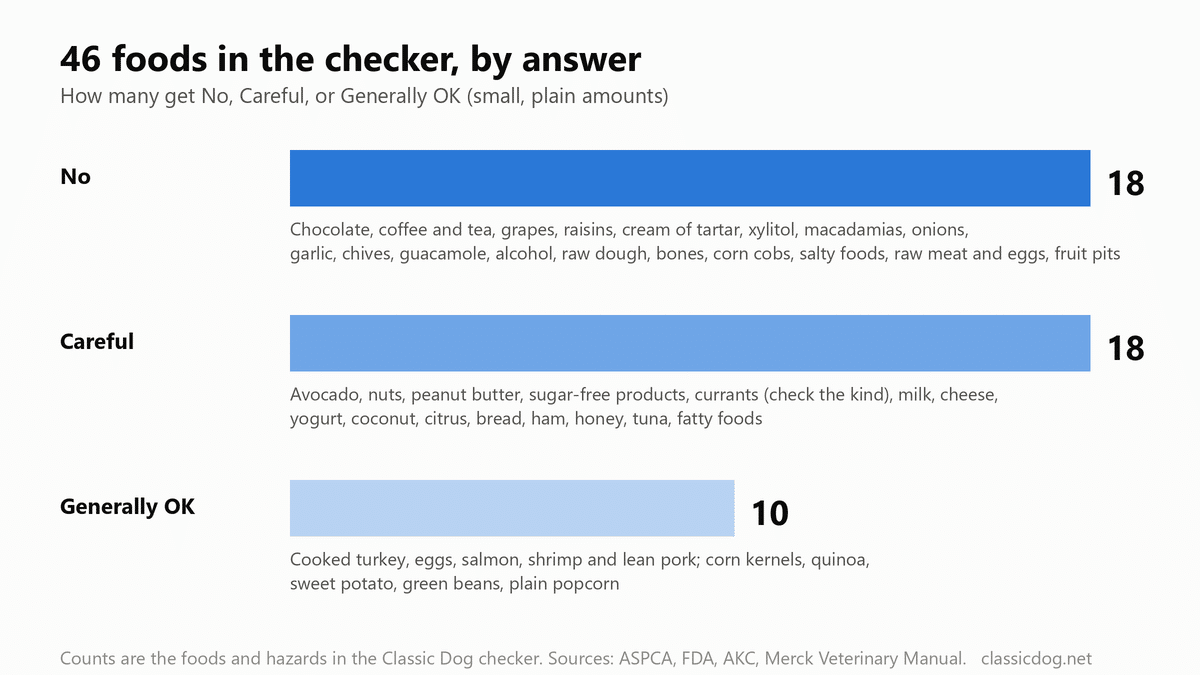
Covers 46 foods and food hazards. Not being listed does not mean a food is safe.
This is general information from the sources listed on this page, not veterinary advice. Dogs differ, and the amount, the dog’s size and its health all matter. Your veterinarian knows your dog.
What the three answers mean
No means the ASPCA, the FDA or the AKC names it as a hazard for dogs. These are the foods to keep out of reach, and I add a reminder to call your vet or poison control if your dog has eaten some.
Careful means it isn’t a flat ban, but something about the form or amount can cause trouble. Peanut butter is the classic case. Plain, it’s an occasional treat. If the label lists xylitol, it’s a hazard.
Generally OK means safe for healthy dogs when it’s plain, cooked where needed, and small. “Plain” carries a lot of weight in that sentence. Almost every food in this group turns into a problem once you add onions, garlic, salt, butter or raisins.
I’m not a vet, and I don’t own a dog. The checker isn’t my opinion. It restates what the sources say, and it names them on every card.
How I built it
I started with the ASPCA’s list of people foods to avoid, then added the FDA’s list of potentially dangerous items for pets. For the “can they have it” side, I used the American Kennel Club’s guide to which human foods dogs can and can’t eat, plus the ASPCA’s Thanksgiving tips, which name sweet potatoes and green beans as things you can mix into a dog’s usual dinner. For grapes and raisins I also read the Merck Veterinary Manual entry.
Where the sources differ, I went with the more careful reading. Avocado is the example. The ASPCA says it’s mainly a problem for birds, rabbits and livestock. The FDA calls it only mildly toxic to dogs. The AKC says the flesh isn’t toxic but is very fatty, and the pit can block the gut. Put together, that’s a “Careful,” not a “No,” and not a “Yes.”
Chocolate shows the other kind of difference, because there are two separate risks. The first is methylxanthines, mainly theobromine and caffeine. The Merck Veterinary Manual lists 28.5 mg per gram in cocoa powder and 5.3 to 5.6 in dark chocolate, but only 0.04 in white chocolate, which it calls a negligible source. So white chocolate isn’t a theobromine worry. The second risk is fat. Merck says chocolate’s high fat content may trigger pancreatitis in susceptible dogs, and the AKC says white chocolate is unsafe for that reason. I list both. For the amounts that matter with real chocolate, the chocolate toxicity calculator is the better tool.
A few entries come from a single study rather than a list. Cream of tartar is one. A case series built from the ASPCA Animal Poison Control Center database found acute kidney injury in 2 dogs after cream of tartar and in 4 after tamarinds. The authors point to tartaric acid, the same compound suspected in grapes and raisins. Two dogs is a small number, so I treat it as a reason to be careful, not as a precise rule. I could only read the abstract of that paper, because the publisher’s site blocked automated access.
A worked example
Say a guest offers your dog a bit of garlic bread. Type “garlic bread” into the checker. You get one card, and it’s a No for the whole dish. The checker spots the garlic, which belongs to the allium family and which the AKC says is three to five times more toxic to dogs than onions. It names the garlic as the trigger, then puts the plain alternative beneath the verdict: a small piece of plain, fully baked bread with no garlic or raisins. There’s no green badge anywhere on that card. “Garlic-bread” with a hyphen gives the same answer.
Preparation counts the same way. “Buttered popcorn” doesn’t get the green badge, because the green verdict for popcorn covers only plain, air-popped, unsalted, unbuttered popcorn. “Seasoned turkey” asks you to check the seasoning ingredients, since onion, garlic or a lot of salt would make it a No. “Smoked salmon” and “lox” get a skip-it caution, because the AKC says their high salt content and low-heat preparation make them poor choices to share. And “turkey with onions” or “popcorn with grapes” get a single No that names the hazardous ingredient.
Now try “turkey bone.” You get a single card, Bones, marked No, since cooked poultry bones can splinter. The safe version of turkey sits inside that card: boneless, skinless, fully cooked meat in a small amount. Same animal, different part of the plate.
The checker reads the preparation as well as the food. “Raw salmon” doesn’t get the green card meant for cooked salmon. It gets a No, with the AKC’s warning about parasites and bacteria. “Guacamole” gets a No, not just the Careful that avocado gets on its own, because recipes vary and some include onion, garlic or a lot of salt. “Sugar-free peanut butter” gets a Careful with a prompt to check the label for xylitol, since “sugar-free” doesn’t say which sweetener is inside. Type “xylitol” or “birch sugar” and it’s a No.
Currants need care too. Zante currants are dried grapes and get a No. Black, red and white currants are true currants (Ribes), which Merck says haven’t been linked to kidney injury, so they get a Careful. If you type just “currants,” the checker asks you to identify the kind first.
The same food, two answers
Most of the confusion about dog food comes from preparation, not the ingredient. This table shows foods that land in different groups depending on how they reach the bowl.
| Food | Plain, small amount | The version that causes trouble |
|---|---|---|
| Turkey | Fully cooked, boneless, skin and fat removed | Raw or undercooked (Salmonella), bones (can splinter), seasoned with onion or garlic |
| Peanut butter | Plain, about a teaspoon or less | Any brand containing xylitol |
| Corn | Kernels with no butter or salt | On the cob (can block the gut) |
| Bread | Small piece of plain, fully baked bread | Raw yeast dough, or bread with raisins |
| Eggs | Fully cooked, no salt or butter | Raw (Salmonella, biotin) |
| Salmon | Fully cooked and deboned | Raw, undercooked, or smoked (too salty) |
| Yogurt | Plain, if your dog tolerates dairy | Sweetened, or with xylitol or cocoa |
What the checker can’t tell you
It covers 46 foods and hazards. That’s a small slice of what’s in a kitchen, so “not in my list” isn’t a safe answer. Apples, carrots and blueberries aren’t in it yet, because I haven’t read a source I trust on them closely enough to quote. I’d rather leave them out than guess.
It also can’t see your dog. Size, age, medical history and the amount eaten all change the risk. The sources say so too: the FDA notes that toxicity depends on the animal, how much it ate and, for plants, which part. A dog with a history of pancreatitis shouldn’t get fatty foods that a healthy dog handles fine, and your vet knows which camp yours is in.
Practical advice
Keep the poison control number somewhere you’ll find it fast. The ASPCA Animal Poison Control Center is (888) 426-4435, and the FDA’s page also lists the Pet Poison Helpline at 855-764-7661. If you’re calling, have the food, the amount and the time ready.
Read labels for xylitol. It turns up in gum, candy, baked goods, toothpaste, and some peanut butter, and the AKC notes it can also appear as “birch sugar” on ingredient lists.
Check what’s in the trash, too. The ASPCA points out that holiday garbage fills up with bones, chocolate and onions, and curious dogs find it. For holiday meals in particular, the Thanksgiving foods guide goes dish by dish, and the Halloween candy guide does the same for candy. For plants, see the toxic plants guide.
If you do share people food, treat it as a treat. It still counts toward the day’s calories, and the dog food calculator helps you see how much room there is.
Sources
- ASPCA. People Foods to Avoid Feeding Your Pets. aspca.org
- ASPCA. Thanksgiving Safety Tips. aspca.org
- U.S. Food and Drug Administration. Potentially Dangerous Items for Your Pet (content current as of Feb. 28, 2023). fda.gov
- American Kennel Club. Which Human Foods Can Dogs Eat and Which Are Dangerous? akc.org
- Merck Veterinary Manual. Grape, Raisin, and Tamarind (Vitis spp, Tamarindus spp) Toxicosis in Dogs (Hayes, reviewed Sept 2024). merckvetmanual.com
- Merck Veterinary Manual. Chocolate Toxicosis in Animals (methylxanthine content table). merckvetmanual.com
- U.S. Food and Drug Administration. Paws Off! Xylitol is Toxic to Dogs (content current as of Feb. 14, 2025). fda.gov
- Wegenast CA, Meadows ID, Anderson RE, et al. Acute kidney injury in dogs following ingestion of cream of tartar and tamarinds and the connection to tartaric acid as the proposed toxic principle in grapes and raisins. J Vet Emerg Crit Care. 2022;32(6):812-816 (abstract read). doi.org/10.1111/vec.13234
Last reviewed: November 21, 2026. Written by Santosh Mahajan. This checker gives general information, not veterinary advice. If your dog has eaten something risky, call your veterinarian or ASPCA Animal Poison Control right away. See the Disclaimer and the Editorial Policy.