Everyone knows the rule: multiply your dog’s age by seven. A 3-year-old dog is 21, a 10-year-old is 70. It’s easy to remember, and I repeated it for years. Then I read a 2020 paper that compared age-related changes in dogs and humans and got a very different answer.
Where the 7 comes from
The paper calls the seven-year rule an adage. It says the rule reflects a deep intuition that development and aging happen at different rates in different species. My guess at where the 7 came from is a division of life spans: if people live to around 70 and dogs to around 10, you get 7. I can’t point you to a study behind it. As a rough way to say “dogs age faster than we do,” it works. As a calculator, it breaks down at both ends.
What the 2020 study did
A team of researchers, led from the University of California San Diego with the National Human Genome Research Institute and others, published their work in Cell Systems. The study compared age-related DNA methylation patterns in dogs and in humans. Methylation is a set of chemical tags on DNA that shift in a predictable pattern as an animal ages. The methods report 104 dogs, primarily Labrador retrievers, from puppies up to 16 years old. Nine dogs were removed because of insufficient sequencing coverage, which leaves 95.
The two lined up on a curve, not a straight line. The fitted formula is:
human age = 16 × ln(dog age) + 31
“ln” is the natural logarithm, the “ln” button on a scientific calculator. The authors fitted the dogs-to-humans match and the humans-to-dogs match separately and got similar formulas (17 ln + 33 one way, 16 ln + 30 the other), then combined them into the one above.
A worked example
Take a dog that’s 3 years old. The natural log of 3 is 1.0986. Multiply by 16 and you get 17.6. Add 31 and you get 48.6, so roughly 49 human years. The 7x rule gives 21.
Take a 12-year-old Labrador. The log of 12 is 2.485. Times 16 is 39.8, plus 31 is 70.8. The 7x rule gives 84. The paper makes the same point from the other direction: it reports that a Labrador’s expected 12-year lifespan translates to 70 human years, the worldwide human life expectancy it uses.
The table below runs the numbers for common ages.
| Dog age (years) | 7x rule (human years) | 2020 formula (human years) |
|---|---|---|
| 1 | 7 | 31 |
| 2 | 14 | 42 |
| 3 | 21 | 49 |
| 5 | 35 | 57 |
| 7 | 49 | 62 |
| 10 | 70 | 68 |
| 12 | 84 | 71 |
| 15 | 105 | 74 |
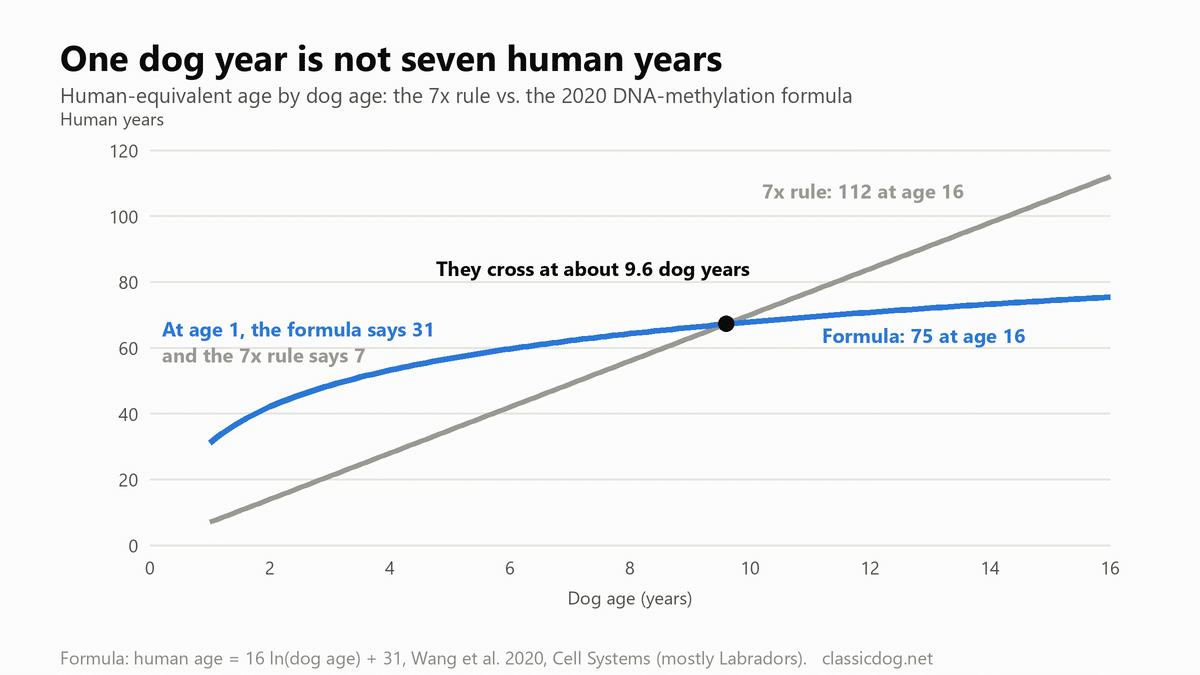
Among dogs aged one year and older, the two formulas agree at about 9.6 years, where both give roughly 67. That’s my arithmetic from the two formulas, not a figure from the paper. Between age 1 and that point, the formula says dogs are much older than 7x suggests. After it, the formula says they’re younger.
What the formula can’t tell you
It’s not a clinical tool. It measures a molecular marker, not how a dog acts, feels or moves. A 1-year-old dog isn’t a 31-year-old person in any way you’d notice at the park. The paper itself says the match was more approximate for adolescents and mature dogs than for seniors, and that the dog epigenome changes faster than human physiology tables would predict at those stages.
The sample was mostly Labradors, a single breed, so the formula tells you little about a Great Dane or a Chihuahua. The paper itself notes that average lifespan differs dramatically across breeds. My own check on the formula also shows its limits with very young puppies: it gives a negative human age for any dog under about 7.5 weeks, since the log of a tiny number is a large negative. It was built from the whole age span, not for newborns.
What vets use instead
The American Animal Hospital Association (AAHA) takes a different approach. In its 2019 canine life stage guidelines, the task force says that, rather than trying to calculate human-age equivalents, life stage should be defined by age and characteristics. Its definitions table lists puppy, young adult, mature adult, senior and end-of-life. It doesn’t propose age ranges for mature adults and seniors, because variation grows in the later years. What it does define is the senior stage: the last 25% of a dog’s estimated lifespan, running through end-of-life. The mature adult stage lasts from the end of physical and social maturation until that point, and both depend on breed and size. Estimating a dog’s expected lifespan, usually from its breed, helps a vet decide which care fits which stage.
That’s a more useful question than “how old is she in human years?” The real one is “what does a dog her size and breed need now?” If you want to see how your dog’s age maps onto both ideas, the dog age calculator uses the 2020 formula. For how long dogs of different breeds live, see the lifespan by breed guide.
Practical advice
Use the human-years number as a fun comparison, not as medical information. Plan care around life stage, and ask your vet when your dog is moving from one to the next. And if a website tells you a 1-year-old is 7, you now know that’s the folk version.
Sources
- Wang T, Ma J, Hogan AN, et al. Quantitative Translation of Dog-to-Human Aging by Conserved Remodeling of the DNA Methylome. Cell Systems. 2020;11(2):176-185.e6. doi:10.1016/j.cels.2020.06.006. pmc.ncbi.nlm.nih.gov
- American Animal Hospital Association. Canine Life Stage Definitions, 2019 AAHA Canine Life Stage Guidelines (published Oct 8, 2019). aaha.org
Last reviewed: November 21, 2026. Written by Santosh Mahajan. This page gives general information, not veterinary advice. See the Disclaimer and the Editorial Policy.