In West Virginia last year, about 1 in 6 dogs that were tested came back positive for exposure to Lyme disease. Ten years earlier it was about 1 in 19. That jump surprised me, so I pulled the numbers for every state from the Companion Animal Parasite Council (CAPC), a veterinary group that publishes test results from the big US diagnostic labs. Pick your state below to see where it stands.
Lyme disease exposure in dogs: look up your state
Pick a state to see how many dogs tested positive for Lyme exposure in 2025, and how that compares with 2015.
Data: Companion Animal Parasite Council (CAPC) parasite prevalence maps, Lyme disease, dogs, full years 2015 and 2025, from tests run by IDEXX, Antech and Zoetis labs. A positive test means the dog was exposed, not that it is sick. Risk bands use the CAPC map’s own cut-offs. This is not veterinary advice.
The short answer
In 2025, CAPC’s map counted 534,274 positive Lyme tests out of 12,832,236 dogs tested in the US. That’s 4.2%, or about 1 in 24. But the national number hides huge differences. In Vermont, Maine, Connecticut and New Hampshire, more than 1 in 10 tested dogs came back positive. In Wisconsin and Minnesota it was about 6% to 7%. In states such as Texas, Arizona and Washington, fewer than 1 in 200 reported tests were positive.
A positive result means the dog has antibodies, so it was bitten by an infected tick at some point. It doesn’t mean the dog is sick. CAPC’s guideline says most exposed dogs appear to develop infections without signs, and most dogs that test positive never show any evidence of disease.
I’m not a vet and I don’t own a dog. Everything here comes from CAPC and the CDC, and I’ve linked both at the end. If you’re worried about your own dog, your vet is the right person to ask.
Where exposure is highest
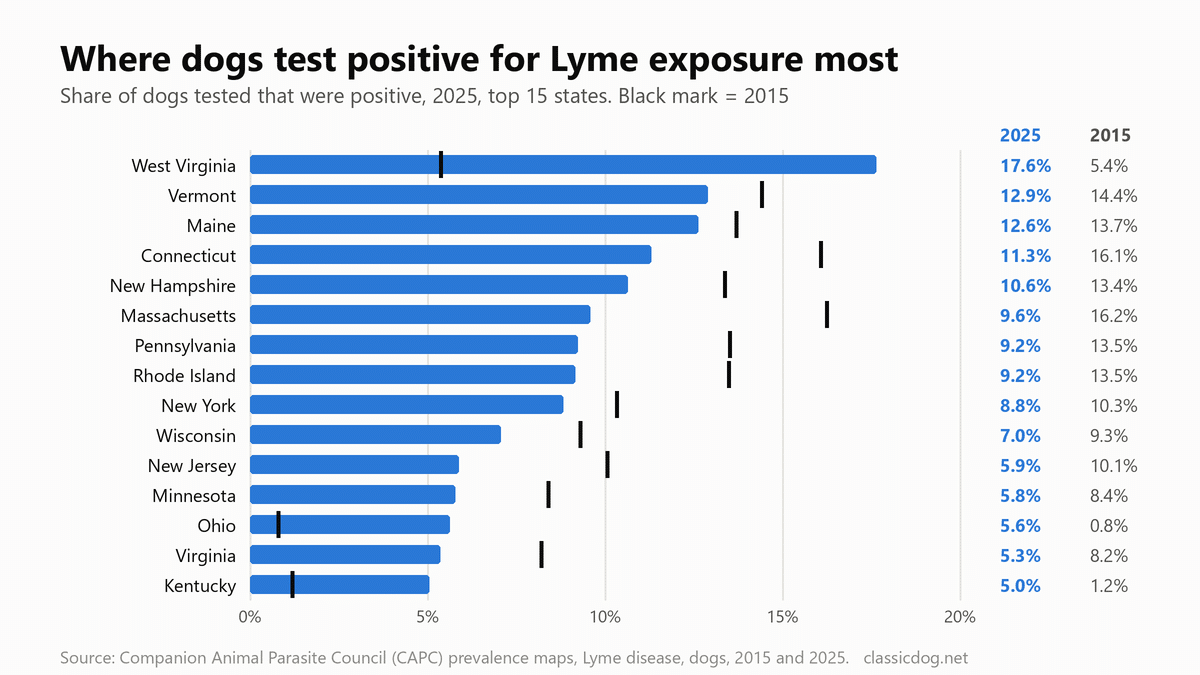
The top of the list is mostly familiar. Vermont, Maine, Connecticut, New Hampshire, Massachusetts, Pennsylvania, Rhode Island and New York all had more than 8% of tested dogs come back positive. CAPC’s guideline names the Northeast, the upper Midwest and the West Coast as the regions where infection is common, and says it’s rarely found in pets in the southern US unless they’ve traveled.
The surprise is where the numbers have climbed. West Virginia now has the highest rate of any state at 17.6%. Ohio and Kentucky both crossed 5%, which is the line the CAPC map uses for its highest risk color. Here are the states with the biggest rises since 2015:
| State | Positive in 2015 | Positive in 2025 | Dogs tested in 2025 |
|---|---|---|---|
| West Virginia | 5.4% | 17.6% | 97,818 |
| Ohio | 0.8% | 5.6% | 683,225 |
| Kentucky | 1.2% | 5.0% | 176,106 |
| Michigan | 1.5% | 4.7% | 650,627 |
| Tennessee | 0.6% | 2.0% | 265,151 |
| Indiana | 3.5% | 4.6% | 339,364 |
Some Northeast states moved the other way. Massachusetts went from 16.2% to 9.6%, and Connecticut from 16.1% to 11.3%. I’d be careful reading that as good news. The number of dogs tested nationwide more than tripled, from about 4 million in 2015 to 12.8 million in 2025, and a bigger pool can change the share that test positive. The data doesn’t tell us why each state moved. What it does show is that high positive rates among tested dogs are no longer limited to New England.
How the state lookup works
The tool shows CAPC’s full-year 2025 figure for the state you pick: positive tests divided by dogs tested. It also shows 2015 for comparison, unless fewer than 1,000 dogs were tested that year, because tiny samples jump around. The color band follows the cut-offs built into CAPC’s own map for Lyme in dogs: under 0.5% is low, 0.5% to under 5% is middle, and 5% or more is high.
A worked example: Ohio had 38,398 positive tests out of 683,225 dogs tested in 2025. 38,398 ÷ 683,225 = 0.0562, so 5.6%, or about 1 in 18 dogs. In 2015, the same figure was 0.8%.
Three limits matter. First, these are dogs whose vets ordered a test, not a random sample of every dog in the state. Second, CAPC says the map shows less than 30% of all the testing happening in each area. Third, an antibody test can’t say when or where a dog met the infected tick. CAPC notes that dogs which traveled to high-risk areas can test positive back home. It’s a useful signal, not a census.
What Lyme disease looks like in a dog
When a dog does get sick, CAPC lists fever, lameness that shifts from leg to leg, swollen joints, enlarged lymph nodes, tiredness and loss of appetite. A less common form affects the kidneys, with signs like weight loss, vomiting and swelling. The bull’s-eye rash that people often get is rare in dogs.
The CDC says signs of tick-borne disease in pets may not show up for 7 to 21 days or longer after a bite. So if you’ve found a tick on your dog, keep an eye on its energy and appetite for the next few weeks, and call your vet if anything changes. Treatment is something your vet decides. CAPC doesn’t recommend antibiotics after a tick bite in a dog that has no signs.
How to protect your dog
Ticks need time. CAPC says an infected tick usually has to feed for about 24 to 48 hours before it can pass on the Lyme bacteria. That’s why the daily check matters so much. Here’s what CAPC and the CDC recommend:
- Check your dog every day it’s been outside, and remove any tick you find right away. Ticks are hard to spot on long or dark fur.
- Use a tick preventive all year. CAPC recommends year-round tick control for every dog. Ask your vet which product fits your dog. If you also have a cat, the CDC warns not to use any tick product on it without asking your vet first.
- Ask about the Lyme vaccine if you live in or travel to a high-risk area. CAPC says the decision should be based on where your dog lives and how often it goes into tick habitat, and that the vaccine doesn’t replace tick control.
- Keep your yard tidy. Clipped grass and trimmed shrubs give ticks and the animals that carry them fewer places to live.
To remove a tick, CAPC advises using forceps or a tick-removal tool and wearing gloves if you can. The CDC’s steps for removing a tick from a person work the same way: grasp it as close to the skin as you can, pull straight out with steady pressure, and don’t twist or jerk. Skip petroleum jelly, heat or nail polish. Clean the spot, and wash your hands afterward.
Does my dog’s Lyme test matter for my family?
Dogs don’t pass Lyme to people. CAPC says pets aren’t an immediate source of human infection, because people get it the same way dogs do, from a tick bite. But a dog can carry ticks into the house, the CDC notes, and those ticks can bite people. CAPC also points to CDC research that found counties where more than 5% of dogs tested positive were linked with human Lyme cases appearing. So a high number for your state is a good reason to check yourself after hikes, too.
If you’re planning your dog’s care for the year, the dog vaccine schedule explains where the Lyme vaccine fits among the lifestyle vaccines, and the dog cost calculator includes yearly flea and tick prevention.
Sources
- Companion Animal Parasite Council. Parasite Prevalence Maps: Lyme disease, dog, United States, 2025 and 2015 (all year). Read November 14, 2026. capcvet.org
- Companion Animal Parasite Council. CAPC Guidelines: Lyme Disease (dog). Updated May 15, 2019. capcvet.org
- Centers for Disease Control and Prevention. Preventing Ticks on Pets. May 15, 2024. cdc.gov
- Centers for Disease Control and Prevention. What to Do After a Tick Bite. June 9, 2026. cdc.gov
Last reviewed: November 14, 2026. Written by Santosh Mahajan. This page summarizes published data and guidelines and isn’t veterinary advice. If your dog seems unwell after a tick bite, please call your vet. See the Disclaimer and the Editorial Policy.