Most of us fill the water bowl without thinking about it. Then one day the bowl is empty by lunchtime and the question comes up: is my dog drinking too much? I wrote this calculator to give a number to look at. It shows a typical daily range for your dog’s weight, and if you measure what your dog drinks for a day, it shows where that falls.
Dog water intake calculator
Enter your dog’s weight to see a typical daily range. If you have measured how much your dog drank over 24 hours, add that too and I’ll show where it falls.
Only water from the bowl. Measure what you pour in and what is left after 24 hours.
Leave blank and I’ll estimate it from weight.
Typical range of 20 to 70 mL per kg and the 100 mL per kg level are from a veterinary referral practice fact sheet. The 1 mL per calorie minimum is a National Research Council estimate cited by Zanghi and Gardner (2018). Sources below. This is not veterinary advice.
The short answer
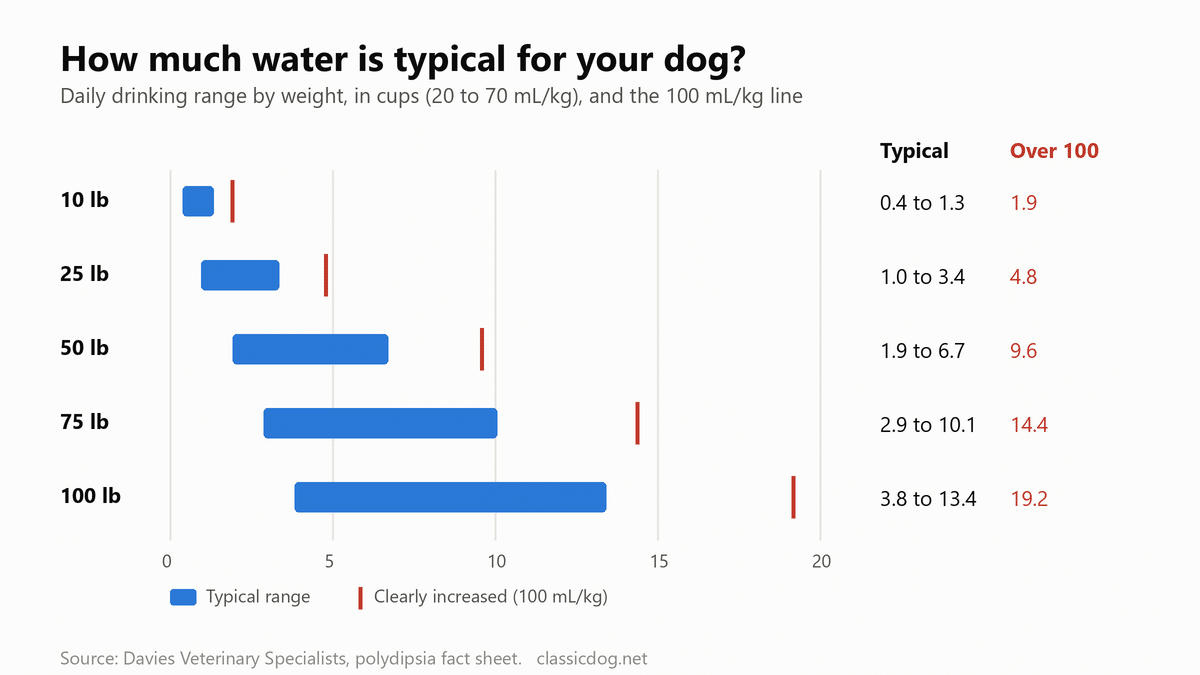
Veterinary textbooks give a normal water intake for dogs of about 20 to 70 mL per kilogram of body weight per day. For a 50 lb dog, that’s roughly 2 to 7 cups. Drinking above about 100 mL per kg a day, which is close to 10 cups for that same dog, is treated as clearly increased. Between the two is a gray area where heat, exercise and diet can all play a part.
I’m not a vet and I don’t own a dog, so I want to be clear about what this is. It’s a way to turn “he seems thirsty” into a figure you can tell your vet. It can’t tell you why a dog is drinking more.
How the calculator works
It uses three figures, all from sources I checked at the original.
- Typical range, 20 to 70 mL/kg/day. A fact sheet from Davies Veterinary Specialists, a UK referral practice, says textbooks give this range for dogs and notes wide differences between individuals.
- Clearly increased, over 100 mL/kg/day. The same fact sheet calls intake “definitively increased” above this level, and adds that some dogs drink noticeably more than usual while staying under it.
- Minimum total water, 1 mL per calorie. A 2018 study by Zanghi and Gardner in Frontiers in Veterinary Science cites the National Research Council’s 2006 estimate of 1.0 mL of water per calorie of food energy as a conservative estimate of a healthy dog’s minimum need. This counts all water, including what’s in the food, so it isn’t the same thing as what comes out of the bowl.
If you leave the calories box empty, the calculator estimates your dog’s daily calories from weight, using the same resting-energy formula as our dog food calculator with a typical factor for a neutered adult. Enter the number from your dog’s feeding plan if you have it.
A worked example
Take a 50 lb dog, which is 22.7 kg. The typical range is 20 × 22.7 = 454 mL to 70 × 22.7 = 1,588 mL. A cup is about 237 mL, so that’s 1.9 to 6.7 cups. The 100 mL/kg level is 2,268 mL, or 9.6 cups. If this dog drank 5 cups (1,183 mL) in a day, that’s 52 mL/kg, comfortably inside the typical range. If it drank 12 cups, that’s 125 mL/kg, and it’s time to call the vet.
| Dog’s weight | Typical range (20–70 mL/kg) | Clearly increased (over 100 mL/kg) |
|---|---|---|
| 10 lb (4.5 kg) | 0.4–1.3 cups | over 1.9 cups |
| 25 lb (11.3 kg) | 1.0–3.4 cups | over 4.8 cups |
| 50 lb (22.7 kg) | 1.9–6.7 cups | over 9.6 cups |
| 75 lb (34.0 kg) | 2.9–10.1 cups | over 14.4 cups |
| 100 lb (45.4 kg) | 3.8–13.4 cups | over 19.2 cups |
These are for drinking from the bowl. Dogs also get water from their food, so a dog on a moist diet can drink less and still be fine. In the Zanghi study the dogs ate dry kibble with about 6% moisture. During the baseline period, before the test waters were introduced, their total water intake averaged 71 mL/kg a day. That total isn’t just the bowl: the study counts drinking water, the moisture in the food and an estimate of the water the body makes when it burns food.
How to measure your dog’s drinking
This is the part that matters most, because the number is only as good as the measurement. Here’s how I’d do it:
- Keep fresh water available the whole time. Never limit water to make measuring easier.
- Fill the bowl with a measured amount, using a measuring cup, in the morning.
- Top it up with measured amounts through the day and write each one down.
- Measure what’s left 24 hours later. Drinking is what you poured in minus what remains.
- Keep other water sources in mind, such as a second bowl, a toilet, or a puddle outside, and block them if you can.
- Repeat for two or three days, because one day can be off. A hot day or a long walk will push the number up.
Spillage and evaporation add a little error, and in a multi-dog home this doesn’t work unless you can separate them. Even so, a rough count over a few days is far more useful than a guess.
Where the lines are blurry
The sources don’t agree perfectly, and it’s worth knowing that. The Davies fact sheet uses 100 mL/kg/day. A 2003 article by veterinarian Carl Osborne in dvm360 puts the upper limit of normal at about 90 mL/kg/day for dogs. The difference is small, but it shows that the line isn’t sharp. That’s why the calculator has a middle zone between 70 and 100 rather than a single cutoff.
Merck Veterinary Manual doesn’t give a single “normal” water intake for healthy dogs that I could find. It does use 60 mL/kg per day as a target when treating dogs with Cushing disease, where excess thirst is one of the main signs, and it lists increased drinking among the signs of conditions such as diabetes insipidus. I mention this only to show how vets use water intake in practice, as a number to track, not a verdict.
What can raise drinking
The Davies fact sheet notes that the water in a dog’s food, and water lost through activity or panting, both affect how much it drinks. So hot weather, hard exercise and a dry diet will all push the number up. Medical causes include Cushing disease and diabetes insipidus, both of which Merck describes as causing excess thirst, which is why a vet should look at a dog that keeps drinking more than usual.
When to call the vet
- Your dog is consistently above 100 mL/kg/day.
- Drinking has clearly gone up compared with what’s normal for your dog, even if it’s under 100.
- More drinking comes with more urinating, accidents in the house, weight loss, vomiting, tiredness or a change in appetite.
- Your dog is barely drinking at all, particularly if it eats dry food or seems unwell.
Bring your measurements. A written log of cups per day over a few days saves your vet time and gives a much clearer picture than “he drinks a lot.”
Don’t cut back on water to fix the problem. A dog that is drinking too much needs a cause found, and restricting water without a vet’s advice can make a sick dog worse.
Sources
- Davies Veterinary Specialists (Linnaeus). Polydipsia in Dogs and Cats (increased drinking) fact sheet. vetspecialists.co.uk
- Zanghi BM, Gardner CL. Total Water Intake and Urine Measures of Hydration in Adult Dogs Drinking Tap Water or a Nutrient-Enriched Water. Frontiers in Veterinary Science. 2018;5:317. pmc.ncbi.nlm.nih.gov
- Osborne CA. The ins and outs of polyuria and polydipsia. dvm360. June 1, 2003. dvm360.com
- Merck Veterinary Manual. Cushing Disease (Pituitary-Dependent Hyperadrenocorticism) in Animals. merckvetmanual.com
- Merck Veterinary Manual. Diabetes Insipidus in Animals. merckvetmanual.com
Last reviewed: November 12, 2026. Written by Santosh Mahajan. This calculator is a rough guide and isn’t veterinary advice. If you are worried about your dog’s drinking, please call your vet. See the Disclaimer and the Editorial Policy.