If you have a new puppy, the vaccine paperwork can look like a code. If you have an adult dog, you may wonder whether the yearly reminder postcard is really needed. This page puts the 2022 vaccination guidelines from the American Animal Hospital Association (AAHA) into plain English, so you know what to ask at the appointment.
I’m not a vet, and I don’t own a dog. I read the AAHA guideline and its dosing table, and what follows is my summary. Your vet decides what your dog gets. Think of this page as a way to follow the conversation.
The short answer
AAHA says all dogs should have these core vaccines, unless there is a medical reason not to: distemper, adenovirus and parvovirus (usually given together in one combination shot, sometimes with parainfluenza), leptospirosis, and rabies. On top of those, some dogs need extra vaccines based on lifestyle and risk, such as Bordetella, Lyme disease, canine influenza and a rattlesnake vaccine.
The guidelines were published in 2022 and updated in 2024. The 2024 update added leptospirosis to the core list for all dogs. If an older web page or your dog’s old records say otherwise, that’s likely the reason.
Puppy vaccine schedule
AAHA’s table gives the puppy series as a range. For the distemper, adenovirus and parvovirus combination, a puppy needs at least three doses between 6 and 16 weeks of age, spaced 2 to 4 weeks apart. A common way this works out is shots at around 8, 12 and 16 weeks. That is my example, not an AAHA schedule, and your vet may pick different dates.
Leptospirosis starts later. AAHA lists two doses, 2 to 4 weeks apart, starting at 12 weeks of age. Rabies is listed as “as required by law,” so the age and rules depend on where you live. Ask your vet or your local health department.
| Vaccine | Puppy series (16 weeks or younger) | Booster at about 1 year | Adult boosters after that |
|---|---|---|---|
| Distemper, adenovirus, parvovirus (combination, with or without parainfluenza) | At least 3 doses between 6 and 16 weeks, 2–4 weeks apart | One dose within 1 year after the last puppy dose | Every 3 years |
| Leptospirosis (killed, 4-serovar) | 2 doses, 2–4 weeks apart, starting at 12 weeks | One dose within 1 year after the last puppy dose | Every year |
| Rabies | As required by law. Ask your vet what your state and county require. | ||
Notice the booster at about one year. AAHA calls for a single dose of the combination vaccine within a year after the last dose of the puppy series, and the same for leptospirosis. It’s easy to miss, so ask your vet to put it on the calendar before you leave the puppy visits.
Adult dogs: how often are boosters needed?
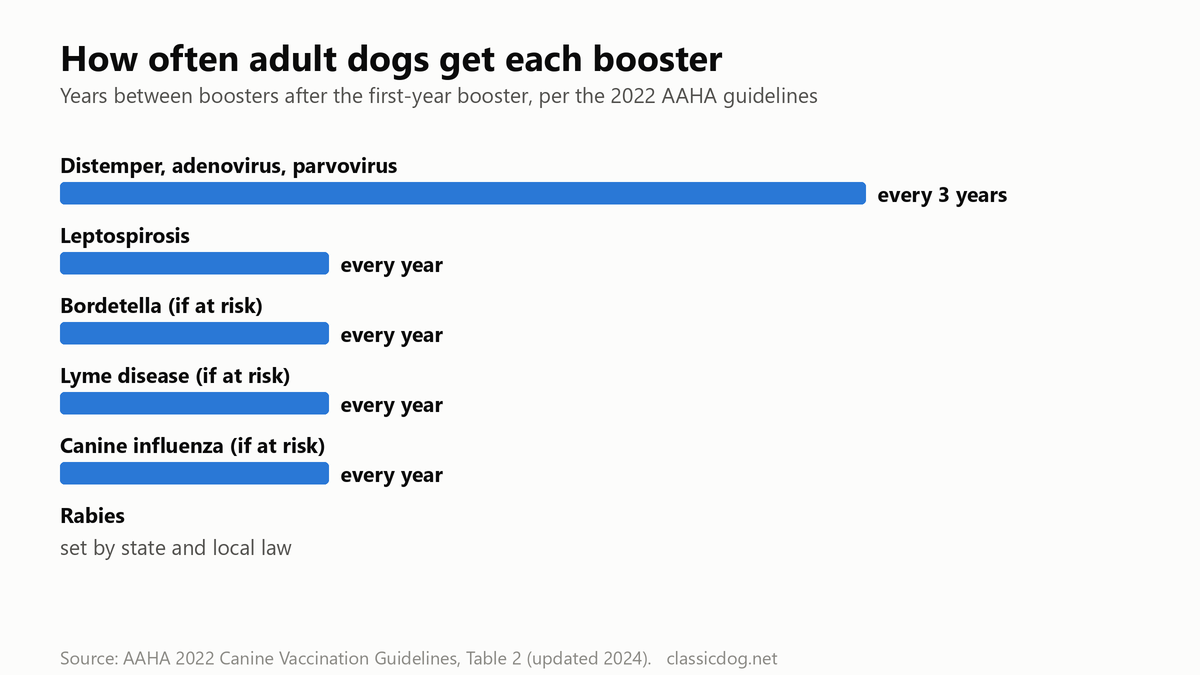
For the core combination vaccine, AAHA recommends boosters every 3 years after the first-year booster, not every year. Leptospirosis is different: AAHA lists a booster every year. Rabies follows the law where you live, so what your vet does with rabies depends on your state and county rules.
If you have an adult dog whose vaccine history is unknown, or whose shots are overdue, AAHA’s guidance is that the benefits of vaccinating far outweigh the risks in dogs with unknown immune status or vaccination history. Its rule of thumb is “When in doubt, vaccinate.” For overdue shots, AAHA says to check the manufacturer’s instructions. For rabies, it says to follow local law and consult the state veterinarian as needed. Your vet will sort this out, so call and ask.
Lifestyle vaccines
These are the ones to talk through with your vet, because the right answer depends on how your dog lives. AAHA’s question for every dog is: what should be added to the core vaccines for this one? Its table calls these vaccines “recommended for some dogs based on lifestyle, geographic location, and risk of exposure.”
| Lifestyle vaccine | Initial doses (dogs over 16 weeks) | Boosters |
|---|---|---|
| Bordetella (kennel cough), with or without parainfluenza | 1 intranasal or oral dose, or 2 injections 2–4 weeks apart | Every year |
| Lyme disease | 2 doses, 2–4 weeks apart | One dose within 1 year after the series, then every year |
| Canine influenza (H3N8/H3N2) | 2 doses, 2–4 weeks apart | One dose within 1 year after the series, then every year |
| Rattlesnake (Western diamondback) | Varies with body weight and exposure risk | Varies |
Here is how I’d read that, and this is my own illustration, not a rule from AAHA. A dog that goes to daycare or a boarding kennel mixes with a lot of other dogs, so Bordetella and influenza are worth asking about. A dog that hikes in tick country may be a candidate for Lyme. A dog that mostly stays home may need none of them. Your vet knows the risks in your area.
Questions to ask your vet
- Which vaccines does my dog need now, and which can wait?
- When is the one-year booster, and can you put it on the calendar today?
- What does our state require for rabies, and how long is this rabies vaccine good for?
- Given where we walk, travel and board, should we add Bordetella, Lyme, influenza or others?
- What reactions should I watch for after the shots, and who do I call?
On that last question, the AAHA guideline covers factors linked with post-vaccination adverse events, but I haven’t gone into those details here. If your dog has had a reaction before, tell your vet before the next appointment.
Rabies and the law
Rabies is the one vaccine where the rules are set outside the vet’s office. The CDC says pet owners can lower their risk by keeping pets up to date on rabies vaccines, and it points readers to their local health department for questions about vaccination. The CDC also says that if you’re bitten by a pet, you should ask the owner for proof that the animal is up to date on its rabies vaccination. That’s one practical reason to keep your dog’s certificate somewhere you can find it.
If a person is bitten or scratched by any animal, the CDC advises washing the wound right away with soap and water for 15 minutes, and contacting the health department if you may have been exposed to rabies.
Costs
Vaccines are part of the first-year costs for any dog. If you’re budgeting, the dog cost calculator includes first vaccines and vet visits, and you can change the amount to match your vet’s prices. If you’re curious how old your dog is in human years, try the dog age calculator.
Sources
- American Animal Hospital Association. 2022 AAHA Canine Vaccination Guidelines (updated 2024). Journal of the American Animal Hospital Association. 2022;58:1–19. aaha.org
- AAHA. Table 2: 2022 AAHA Core and Noncore Vaccines for Dogs (updated 2024). aaha.org (PDF)
- Centers for Disease Control and Prevention. Rabies Prevention and Control (July 1, 2025). cdc.gov
Last reviewed: October 31, 2026. Written by Santosh Mahajan. This page summarizes published guidelines and isn’t veterinary advice. Your vet decides which vaccines and dates are right for your dog. See the Disclaimer and the Editorial Policy.