
I own no dog, which is why I like old dog books. There’s no habit to defend. I downloaded two from Project Gutenberg, both written for ordinary owners in England in the first years of the 1900s, and read the parts on feeding and sickness with a modern vet manual open beside them.
Some of it is better than you’d expect. Some of it would hurt a dog today. Here’s what I found.
The two books
Dogs and All About Them by Robert Leighton is a general guide to breeds and keeping dogs. The preface mentions 1909 licence figures, so it dates from around 1910. It says more than 2 million dog licences were taken out in the British Isles in 1909, and that the family dog “has become a respectable member of society”. A Manual of Toy Dogs: How to Breed, Rear and Feed Them by Mrs. Leslie Williams was first published in 1904. The text I read is the 1919 third edition. Both are in the public domain in the US, which is why I can quote them.
They were written in Britain, not America, and for readers who might have a kitchen, a yard and often a servant. I’m comparing advice, not judging the authors. They worked from what vets of the day knew.
Feeding: meat and biscuit
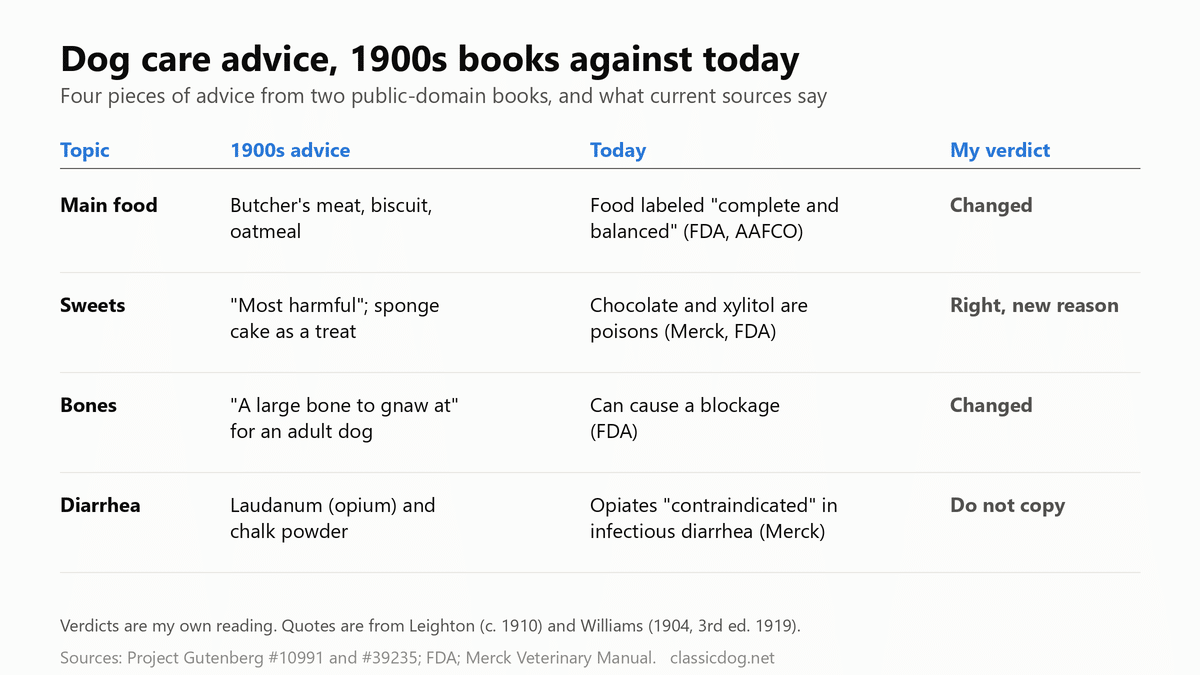
Leighton’s rule for the adult dog is “one good meal a day, served by preference in the evening”, with a dry dog-cake or a handful of meal for breakfast. He says the dog is “by nature a carnivorous animal” and that “wholesome butcher’s meat is without question the proper food”. Oatmeal, rice and linseed meal are occasional extras, and “of the various advertised dog foods, many of which are excellent, the choice may be left to those who are fond of experiment”. Mrs. Williams is stricter for toy puppies. She wants meat cut small, given three times a day and later twice, with a little sponge cake or biscuit for bulk, and “no gravy, milk, vegetables, nor any liquid but water”.
The two authors disagree with each other, which tells you how little was settled. Leighton recommends vegetables and Mrs. Williams bans them.
Today the standard is different. The FDA says that when a pet food label says “complete and balanced”, the food is meant to be a pet’s sole diet, and that it earns the claim by meeting an AAFCO nutrient profile or passing an AAFCO feeding trial. A butcher’s-meat diet couldn’t make that claim on its own. I haven’t worked out which nutrients meat alone is short of, since the sources I read don’t say. Still, that’s the main thing that changed in the last century, and it’s a good change.
Sweets and pastry
Leighton says that “giving sweets, pastry, and rich dainties, is most harmful, and must produce disastrous results”. He means fat dogs and upset stomachs. He’s right that they’re bad. But he was missing the reason that matters most today, which is poisoning. The Merck Veterinary Manual lists chocolate as a source of theobromine and caffeine at doses that can cause seizures, and the FDA says xylitol, a sweetener in sugar-free gum and candy, can drop a dog’s blood sugar within an hour. Neither would have been a worry in a house where the sweets were bread pudding. I wrote about both in the Halloween candy guide.
Mrs. Williams suggests small sweet biscuits or sponge cake as a treat. Plain sponge cake isn’t a poison, but I’d check any modern biscuit or baked good for xylitol, which the FDA lists in baked goods and some nut butters.
Bones
This is where the books disagree with each other again. Leighton suggests “a large bone to gnaw at” for the adult dog. His Yorkshire Terrier chapter says bones shouldn’t be given, because gnawing them spoils the long beard and moustache. He also quotes an earlier author who blames bones for constipation, bad teeth and “fetid breath”.
The FDA’s list of potentially dangerous items for pets says bones can lodge in the throat, stomach or intestines and cause a gastrointestinal obstruction. The reason has changed, but the Yorkie owners were right to be careful.
Stomach trouble and medicine
This is the part I wouldn’t copy. Leighton’s list of remedies for diarrhea includes laudanum, which is opium in alcohol, in drops to “cut short an attack”, and chalk with opium powder, three times a day. He does say diarrhea “is, it must be remembered, a salutary one”, and that unless it becomes excessive you should not interfere, which is better advice than most of the book.
The Merck Veterinary Manual, in its section on drugs for diarrhea, says opiates “are contraindicated in infectious diarrhea” and “should be used cautiously”, and lists constipation and bloat as common side effects in dogs. Please don’t give your dog any human medicine without asking your vet. That includes anything in the medicine cabinet that you think is gentle.
What held up
Some of it is plain good sense and needs no source. Leighton says feeding should be one person’s job, because “when it is everybody’s and nobody’s duty he is apt to be neglected at one time and overfed at another.” He wants clean water always available, regular access to the yard, and “abundant exercise”. Mrs. Williams warns that a toy dog’s lack of appetite shouldn’t be ignored: a dog can miss one meal, but if a second is refused, take the temperature and look for illness. I’m not a vet, but that fits with how I’d want a worried owner to behave.
The biggest difference isn’t any single piece of advice. It’s that these writers had opinions where we now have tested tables and dose thresholds, and they stated them with confidence. I try to keep that in mind when I write here. If you want to see how I check numbers today, the dog food calculator page lists the sources behind each figure.
Sources
- Leighton R. Dogs and All About Them. Project Gutenberg eBook #10991. gutenberg.org
- Williams L, Mrs. A Manual of Toy Dogs: How to Breed, Rear, and Feed Them (1904; 3rd ed. 1919). Project Gutenberg eBook #39235. gutenberg.org
- US Food and Drug Administration. “Complete and Balanced” Pet Food. fda.gov
- US Food and Drug Administration. Potentially Dangerous Items for Your Pet. fda.gov
- US Food and Drug Administration. Paws Off Xylitol; It’s Dangerous for Dogs. fda.gov
- Merck Veterinary Manual. Chocolate Toxicosis in Animals. merckvetmanual.com
- Merck Veterinary Manual. Drugs Used to Treat Diarrhea in Monogastric Animals. merckvetmanual.com
Last reviewed: October 24, 2026. Written by Santosh Mahajan. This is a history piece, not medical advice, and I’m not a vet. Don’t use any remedy from an old book. See the Disclaimer and the Editorial Policy.