Most of the Halloween candy that ends up in a dog’s stomach is harmless apart from the sugar. A few things aren’t, and they’re easy to miss because they look like nothing: a stick of gum at the bottom of a trick-or-treat bag, a snack box of raisins, a handful of dark chocolate someone left on the coffee table.
If your dog has already eaten something, call your vet, an emergency clinic, or the ASPCA Animal Poison Control Center at (888) 426-4435 first and read this later. The ASPCA’s advice is to note the amount and the product and call right away.
Chocolate
Chocolate is the one everyone knows. It contains theobromine and caffeine, which dogs process slowly. The Merck Veterinary Manual gives average amounts per ounce: about 64 mg for milk chocolate, 150 to 160 mg for dark or semisweet, 440 mg for baking chocolate, and 807 mg for cocoa powder. White chocolate has almost none.
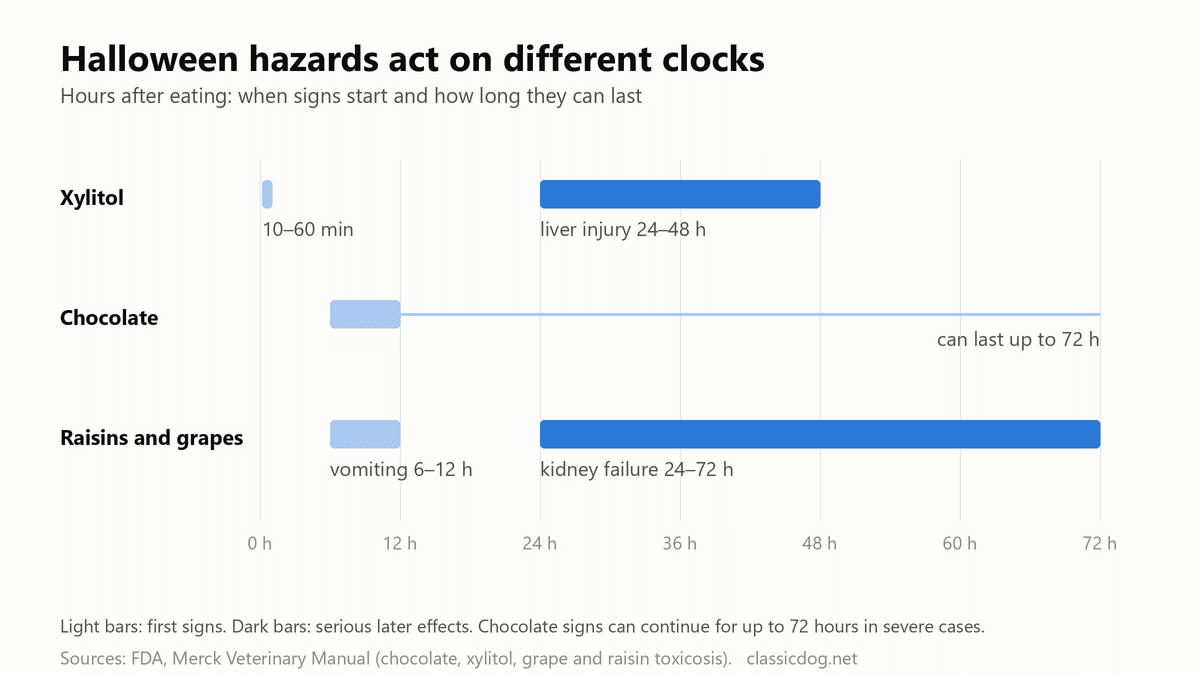
What matters is the dose per pound or kilogram of dog. Merck lists about 20 mg/kg as the level for vomiting and diarrhea, 40 to 50 mg/kg for effects on the heart, and 60 mg/kg or more for seizures. It also says signs usually appear 6 to 12 hours after eating, which means a dog can look fine for a good part of the evening. I built a chocolate toxicity calculator that does the math if you have the weight and the amount.
Sugar-free gum and candy: xylitol
This is the one I’d worry about most, because it’s quick and because the packaging gives no hint. Xylitol is a sweetener used in sugar-free gum, candy and mints, and the FDA also lists baked goods, some peanut and nut butters, toothpaste, mouthwash, cough syrup, chewable vitamins and supplements. It may be listed as birch sugar on a label.
In dogs, xylitol makes blood sugar drop. The FDA says this can begin within 10 to 60 minutes of eating it, with vomiting followed by weakness, staggering, collapse and seizures, and that some serious effects may not show up for 12 to 24 hours. The Merck Veterinary Manual puts the threshold for low blood sugar at roughly 100 mg/kg (45 mg per pound) and says liver injury is occasionally seen above 500 mg/kg, with liver signs often not appearing until 24 to 48 hours or later. It also notes that gums can slow absorption, so low blood sugar can be delayed by as much as 12 to 18 hours.
For a 20 lb dog (about 9 kg), 100 mg/kg works out to roughly 900 mg of xylitol. I haven’t found a reliable figure for how much xylitol a piece of gum holds that applies to every brand, so I can’t tell you how many pieces that is. The label may not say. If your dog got into a bag of sugar-free candy, treat it as an emergency, and the FDA says to go to a vet or emergency hospital right away because your dog may need monitoring for up to a day.
Raisins
Snack boxes of raisins get handed out at Halloween, and they’re more dangerous than they look. The Merck Veterinary Manual says more than one grape or raisin per 4.5 kg (10 lb) of body weight may contain enough tartaric acid to pose a risk to a dog’s kidneys. A 20 lb dog would need only a couple. The amount varies from fruit to fruit, which is why vets don’t promise a safe number.
Vomiting or diarrhea usually starts within 6 to 12 hours, and kidney failure can follow within 24 to 72 hours. Merck says early decontamination and IV fluids are the main treatment, and that a dog that stops making urine is unlikely to survive without dialysis. So a dog that has eaten raisins needs a vet call even if they seem fine.
Wrappers, sticks and hard candy
These aren’t poisons, but they can block the intestine. The FDA’s list of potentially dangerous items for pets says that swallowed items can cause a gastrointestinal obstruction. I didn’t find a source that puts a number on wrappers or lollipop sticks, so I’d treat them like any other swallowed object: if your dog is vomiting, won’t eat, or seems sore in the belly after a candy raid, call the vet.
A quick comparison
| Treat | What does the harm | When signs start | Threshold in the sources |
|---|---|---|---|
| Chocolate | Theobromine and caffeine | Usually 6–12 hours | About 20 mg/kg for mild signs, 40–50 mg/kg for heart effects, 60+ mg/kg for seizures |
| Sugar-free gum, candy, mints | Xylitol | 10 minutes to 1 hour for low blood sugar; liver injury after 24–48 hours | Over about 100 mg/kg for low blood sugar, over 500 mg/kg for liver injury |
| Raisins (snack boxes, trail mix) | Possibly tartaric acid; kidney injury | Vomiting in 6–12 hours; kidney failure in 24–72 hours | More than about 1 raisin per 10 lb of dog may be a risk |
| Wrappers, sticks, hard candy | Blockage in the gut | Varies | No threshold; any swallowed amount can matter |
What to do
Call first, and have the facts ready. The dog’s weight, what the product was, how much could be gone, and when. Keep the wrapper. That’s the information a vet or poison control needs to work out the dose.
Don’t induce vomiting at home on your own. Merck says vomiting can be induced in a dog that’s acting normal, usually within about 2 hours of chocolate ingestion, but it uses drugs a vet picks, and the right choice depends on what was eaten.
Don’t wait for signs. For chocolate and raisins especially, the first signs come hours after the mistake. For xylitol, low blood sugar can start within the hour.
Prevention is the part you can control. Put the bowl on a high shelf, not the counter. Tell kids that candy bags stay out of dog reach, and that includes bedrooms. Use a bin with a lid. If your dog dashes for the door when the bell rings, a gate or a leash for the evening is easier than a vet visit at midnight.
Sources
- Merck Veterinary Manual. Chocolate Toxicosis in Animals. merckvetmanual.com
- Merck Veterinary Manual. Xylitol Toxicosis in Dogs. merckvetmanual.com
- Merck Veterinary Manual. Raisins and Grapes (grape, raisin and tamarind toxicosis in dogs). merckvetmanual.com
- US Food and Drug Administration. Paws Off Xylitol; It’s Dangerous for Dogs. fda.gov
- US Food and Drug Administration. Potentially Dangerous Items for Your Pet. fda.gov
- ASPCA. People Foods to Avoid Feeding Your Pets. aspca.org
Last reviewed: October 24, 2026. Written by Santosh Mahajan. This page is general information, not veterinary advice, and I’m not a vet. If your dog has eaten any of these, please call your vet or poison control. See the Disclaimer and the Editorial Policy.