When a vet says a dog needs to lose weight, the next question is usually “how long will that take?” The answer surprises a lot of owners: longer than you’d hope, and on purpose. Vets aim for a slow, steady loss of 1 to 2% of body weight a week. For a 60 lb dog, that’s about 0.6 to 1.2 lb a week.
Here’s where that number comes from, how to work it out for your own dog, and what to do when the scale stops moving.
The target: 1 to 2% a week
The 2014 AAHA Weight Management Guidelines, written by a panel of vets and board-certified veterinary nutritionists, set the desired rate of weight loss in dogs at 1 to 2% of body weight per week. (For cats it’s 0.5 to 2%.) Faster isn’t better. The guidelines warn that losing weight too quickly can cost a dog muscle as well as fat, and they ask vets to check muscle condition alongside body condition so they can catch this.
Some dogs are expected to lose more slowly. AAHA lists dogs with conditions like an underactive thyroid or Cushing’s disease (hyperadrenocorticism), at least until the condition is treated. Puppies under a year old are a special case too. They still need enough food to finish growing, so the aim may be to slow their weight gain rather than make them lose.
How to work out your dog’s weekly rate
AAHA gives a simple formula. Take the weight lost since the last weigh-in, divide by the weight at that last weigh-in, multiply by 100, then divide by the number of weeks in between.
Here’s an example. Your dog weighed 60 lb on the first of the month and 57.8 lb three weeks later. That’s 2.2 lb lost. 2.2 ÷ 60 × 100 is 3.7%, and 3.7% over 3 weeks is about 1.2% a week. Right on target.
Use the same scale each time if you can. The trend over several weigh-ins tells you far more than any single number, so don’t panic over one bad week.
How long it takes to reach the goal
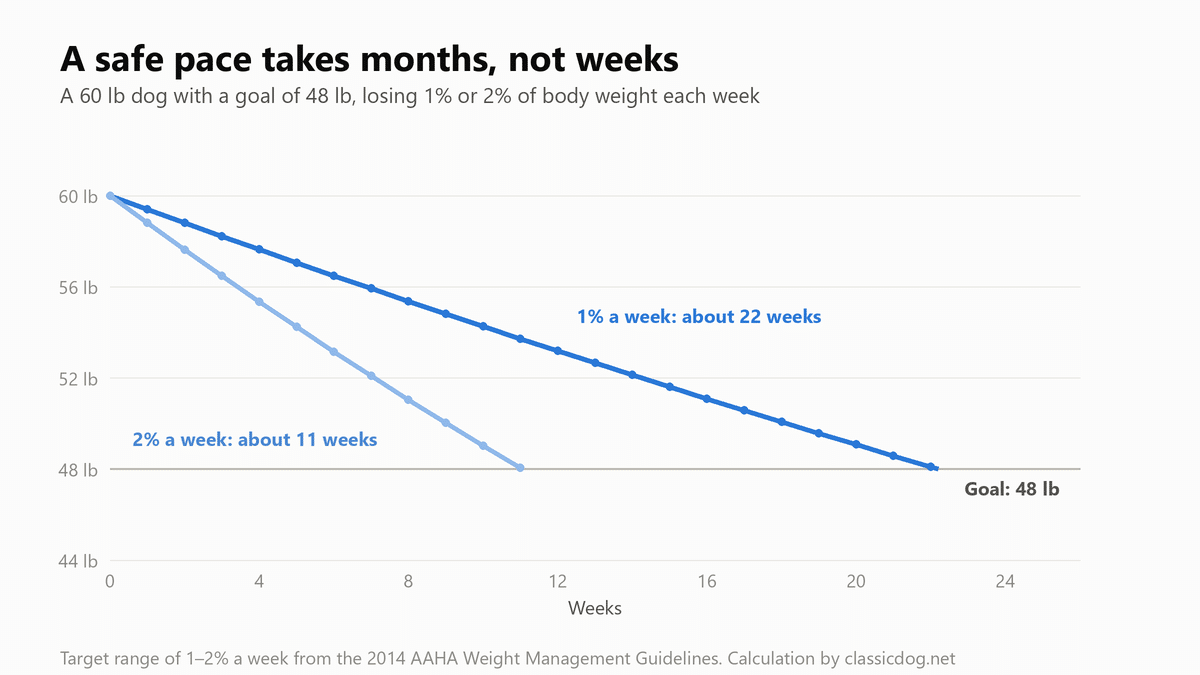
Because the 1 to 2% is taken from the dog’s current weight each week, the pounds lost per week get a little smaller as your dog slims down. The table below shows roughly how many weeks it takes to lose a given share of body weight at each end of the target range.
| Weight to lose (share of current weight) | Example: a 60 lb dog | Weeks at 1% a week | Weeks at 2% a week |
|---|---|---|---|
| 10% | 60 to 54 lb | About 10 | About 5 |
| 15% | 60 to 51 lb | About 16 | About 8 |
| 20% | 60 to 48 lb | About 22 | About 11 |
| 25% | 60 to 45 lb | About 29 | About 14 |
| 30% | 60 to 42 lb | About 35 | About 18 |
Take a 60 lb dog with a body condition score of 7, which AAHA counts as about 20% overweight. A reasonable first goal would be about 48 lb. At 1% a week that takes around 22 weeks, or about five months. At 2% a week it takes around 11 weeks. Most dogs end up somewhere in between.
For a real-world check, a 2017 study followed 926 overweight pet dogs at 340 vet practices in 27 countries through a 3-month weight-loss plan using commercial weight-loss diets. 97% of the dogs lost weight. The average loss was 11.4% of starting weight, which works out to just under 1% a week. Owners also rated their dogs as more active and with a better quality of life as the weeks went on, and less focused on begging for food.
How many calories that means
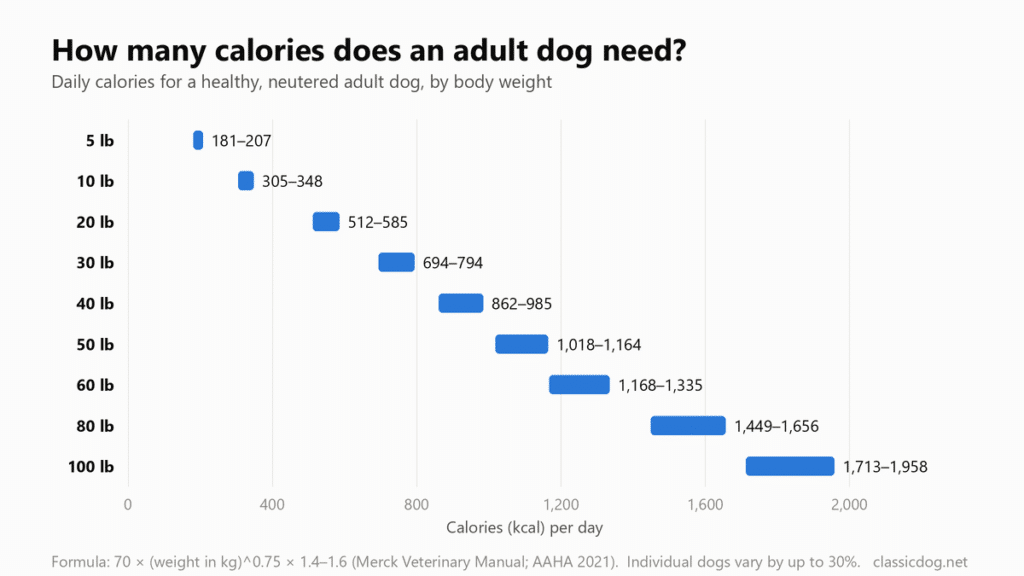
Weight loss calories are worked out from the dog’s ideal weight, not the current one. The usual starting point is resting energy: 70 × ideal weight in kg0.75. For a dog whose goal is 48 lb (21.8 kg), that’s about 706 kcal a day.
The guidelines don’t all use the same multiplier, and I think it’s worth being upfront about that. AAHA’s 2014 guidelines say feeding 80% of resting energy at ideal weight is effective and well tolerated, which would be about 565 kcal for our dog. AAHA’s 2021 guidelines use a factor of 1.0, so about 706 kcal. The 2021 guidelines also cite recent data showing dogs on weight-loss plans ate an average of 63 kcal per kg0.75 over 12 weeks, about 635 kcal for this dog. All of these are starting points. What matters is the weekly rate you actually see on the scale, and your vet will adjust the amount to hit it.
If you’d like the arithmetic done for you, the dog food calculator has a weight-loss setting that uses the 2021 AAHA factor and turns calories into cups of your dog’s food.
Why the food matters, not only the amount
It’s tempting to feed less of the usual food. The 2014 guidelines say this often fails, because the dog stays hungry, and cutting a regular maintenance food far enough can leave the dog short of some essential nutrients. Diets made for weight loss are fortified to cover this. AAHA’s 2021 guidelines add that higher protein helps a dog keep muscle while cutting calories, and that protein and fiber help dogs feel full.
Exercise helps, but less than most people expect. AAHA’s 2021 guidelines say exercise plays a minimal role in weight loss compared with diet, though it does help a dog keep lean muscle. So walks are good for your dog in lots of ways, but they won’t make up for an extra cup of kibble.
Treats count. AAHA advises keeping all extras to 10% of daily calories or less, and that includes table scraps, chews and food used to give pills. Some owners take part of the day’s kibble and use it as treats, which is an easy way to keep the total under control.
When the weight stops dropping
The 2014 guidelines say weight loss is seldom a straight line. As a dog loses weight, their body adapts and burns fewer calories, so loss slows down. The fix is to adjust the feeding plan with your vet, not to give up. AAHA recommends follow-ups every two weeks until the right rate is established, then monthly until the dog reaches the goal weight and holds it.
Once your dog reaches the goal, don’t go straight back to the old portions. If the dog is still losing at the goal weight, AAHA suggests raising calories by just 10%, then weighing every two weeks until the weight is stable. The 2014 guidelines note that many pets still need fairly few calories to hold their new weight, and some need no more than they ate while dieting.
Is it worth it?
I think so. The Merck Veterinary Manual says even very modest weight loss is well established as improving function in overweight dogs with arthritis. And a large 2019 study of more than 50,000 pet dogs found that dogs overweight in middle age had shorter median lifespans in all 12 breeds studied. I wrote about that study in more detail in the body condition score guide.
Please plan the weight loss with your vet, especially if your dog has joint problems, a medical condition or a lot to lose. AAHA recommends that vets refer a dog to a board-certified veterinary nutritionist if the dog needs to eat less than 60% of resting energy to lose weight. That’s a sign the plan needs expert help.
Sources
- Brooks D, et al. 2014 AAHA Weight Management Guidelines for Dogs and Cats. Journal of the American Animal Hospital Association. 2014;50(1):1–11. aaha.org (PDF)
- Cline MG, et al. 2021 AAHA Nutrition and Weight Management Guidelines for Dogs and Cats: Weight Reduction in the Obese Pet; Prevention of Obesity; Use of Therapeutic Diets Designed to Promote Weight Loss. aaha.org
- Flanagan J, Bissot T, Hours MA, Moreno B, Feugier A, German AJ. Success of a weight loss plan for overweight dogs: The results of an international weight loss study. PLoS ONE. 2017;12(9):e0184199. journals.plos.org
- Merck Veterinary Manual. Osteoarthritis in Dogs and Cats. merckvetmanual.com
- Salt C, Morris PJ, Wilson D, Lund EM, German AJ. Association between life span and body condition in neutered client-owned dogs. Journal of Veterinary Internal Medicine. 2019;33(1):89–99. pmc.ncbi.nlm.nih.gov
Last reviewed: October 17, 2026. Written by Santosh Mahajan. This guide explains published veterinary guidelines and isn’t veterinary advice. Please plan any weight loss with your vet. See the Disclaimer and the Editorial Policy.