
How long will my dog live? It’s the question behind a lot of searches, and it’s one with no neat answer. But there is real data now, and it shows some clear patterns. A big 2024 study of more than half a million dogs put numbers on lifespan by breed, size, face shape and sex. This page walks through what it found, and what it can and can’t tell you about your own dog.
I’m not a vet and I don’t own a dog. Every figure below comes from the study itself, which I read at the original. I have checked each number against the paper.
The short answer
In this study, the median lifespan across all dogs was 12.5 years. Purebred dogs had a median of 12.7 years, and crossbreds 12.0. Small breeds lived longest (12.7 years), large breeds shortest (11.9), and flat-faced breeds had the shortest lifespans of any face shape (11.2). The range between breeds is wide, from about 15 years at the top to about 5 at the bottom.
Median means the middle: half the dogs lived longer than this, and half shorter. It isn’t a promise for any one dog.
Where the numbers come from
The study, “Longevity of companion dog breeds: those at risk from early death,” was published in Scientific Reports in 2024 by researchers at Dogs Trust and Liverpool John Moores University in the UK (McMillan and colleagues). They pooled records on 584,734 dogs from 18 different UK sources, including breed registries, vets, pet insurers and animal welfare charities. Of those dogs, 284,734 had died, and the rest were still alive when the data were collected. The study covered 155 recognized breeds plus crossbreds.
These are UK dogs. The authors say plainly that the results represent the UK dog population only and shouldn’t be used to draw conclusions about other countries. I’ll come back to what that means for US readers below.
Lifespan by size, face shape and sex
| Group | Median lifespan (years) |
|---|---|
| All dogs | 12.5 |
| Purebred | 12.7 |
| Crossbred | 12.0 |
| Small purebreds | 12.7 |
| Medium purebreds | 12.5 |
| Large purebreds | 11.9 |
| Medium-length muzzle (mesocephalic) | 12.8 |
| Long muzzle (dolichocephalic) | 12.1 |
| Flat face (brachycephalic) | 11.2 |
| Females | 12.7 |
| Males | 12.4 |
A few patterns stand out:
- Bigger dogs die earlier. Large purebreds had a median of 11.9 years, compared with 12.7 for small ones. The gap showed up in both males and females.
- Flat faces carry a cost. Brachycephalic breeds, the flat-faced ones like Pugs and Bulldogs, had a median of 11.2 years, against 12.8 for breeds with a medium-length muzzle.
- Size and face shape together matter most. Small breeds with long muzzles had the longest median, at 13.3 years. Medium-sized flat-faced breeds had the shortest, at 9.4 years. Large flat-faced breeds came in at 10.7.
- Females outlived males by about 0.3 years overall (12.7 against 12.4).
- Crossbreds lived a little less than purebreds in this dataset, 12.0 against 12.7 years. The authors treated all crossbreds as a single group, though they vary a lot, so this is a rough comparison.
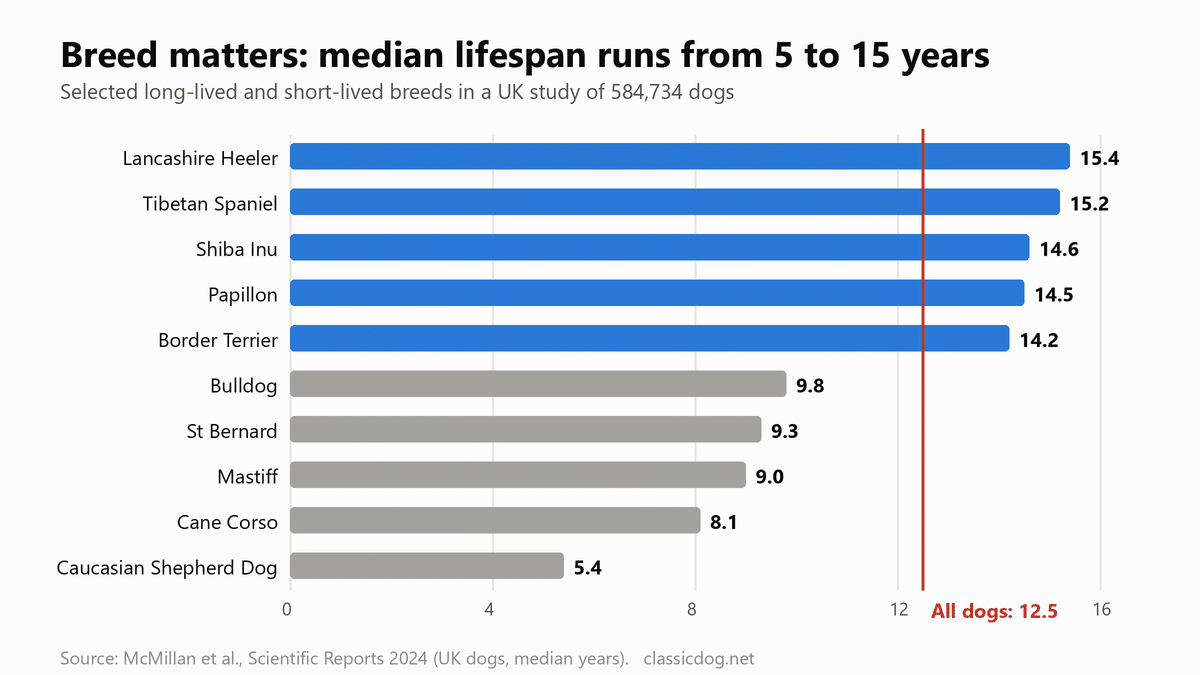
Breeds with the longest and shortest lives
These are the study’s median lifespans for breeds at each end, along with a few popular breeds for comparison.
| Longest median lifespan | Years | Shortest median lifespan | Years |
|---|---|---|---|
| Lancashire Heeler | 15.4 | Caucasian Shepherd Dog | 5.4 |
| Tibetan Spaniel | 15.2 | Presa Canario | 7.7 |
| Shiba Inu | 14.6 | Cane Corso | 8.1 |
| Papillon | 14.5 | Mastiff | 9.0 |
| Border Terrier, Lakeland Terrier, Schipperke | 14.2 | St Bernard, Bloodhound | 9.3 |
| Miniature Dachshund, Italian Greyhound | 14.0 | Bulldog, French Bulldog | 9.8 |
| Labrador Retriever, Border Collie | 13.1 | Pug | 11.6 |
A quick note on the extremes. The Caucasian Shepherd Dog’s median of 5.4 years is far below every other breed, and the study’s own confidence range for it is wide (the hazard ratio runs from 1.6 to 3.7), so I’d treat that one figure with extra care. The pattern across breeds is the main takeaway: the long-lived breeds are small and long-muzzled, while the shortest-lived are giant or flat-faced breeds, with the mastiff-type dogs especially short.
What this means for you
- It’s a range, not a deadline. A breed’s median says where the middle of a large group falls. Individual dogs live much longer or shorter than it. In the study, 95% of the purebred dogs that died had done so by 18.3 years.
- Breed is only part of it. The study didn’t record cause of death, so it can’t tell you what shifts the odds for one dog.
- If you’re choosing a breed, this is one input among many. It’s reasonable to know that some breeds have shorter lives on average, and to plan for it, including the cost of care. You can use the dog cost calculator to see what a lifetime might cost.
- If you already have a dog, the dog age calculator shows where your dog is in life, and a vet can tell you what matters for your dog’s breed and size.
Limits of the study
The authors list several. The results apply to the UK. Cause of death wasn’t recorded. Because the data came from registries, insurers and clinics, some sources may be biased. The authors note, for example, that older animals are often uninsured and that not every owner insures their pet. Neuter status was left out of the analysis because of data limitations, even though earlier research has linked neutering with survival. Many dogs were still alive when data collection ended, which the researchers handled statistically. Giant breeds weren’t analyzed as a separate size class, so they’re covered only through the breeds listed above, such as Mastiffs and Saint Bernards.
For US readers, dogs here can differ in breed mix, vet care and lifestyle, so the exact numbers may differ. I haven’t compared US figures for this page, so please read these numbers as UK data.
Sources
- McMillan KM, Bielby J, Williams CL, Upjohn MM, Casey RA, Christley RM. Longevity of companion dog breeds: those at risk from early death. Scientific Reports. 2024;14:531. pmc.ncbi.nlm.nih.gov
Last reviewed: October 31, 2026. Written by Santosh Mahajan. This page summarizes one published study of UK dogs and isn’t veterinary advice. See the Disclaimer and the Editorial Policy.