Enter your dog’s weight and life stage to get a daily calorie target. If you also type in the calorie figure from your dog food bag, it turns that into grams or cups per day. Below the calculator I explain the formula, how to find the number on the label, and why the result is a starting point you’ll need to adjust.
Dog food calculator
A starting point only, based on Merck Veterinary Manual and AAHA formulas (sources below). Not veterinary advice. Pregnant or nursing dogs, and dogs with medical conditions, need a vet’s plan.
Why the feeding chart on the bag is only a rough guide
The feeding guide printed on a bag of dog food is written for an average dog of each weight. Your dog isn’t average. Being neutered, how active they are, their age and even where they live all change how much energy they burn. The Merck Veterinary Manual notes that dogs living in homes often need fewer calories than dogs kept in kennels, and that two dogs of the same weight can differ by as much as 30% in what they need.
So no calculator, this one included, can tell you the exact right amount. What it can do is give you a sensible starting number based on your dog, rather than on a chart written for every dog at once.
How the calculator works
Vets usually work out a dog’s calorie needs in two steps.
Step 1: resting energy. This is the energy a dog uses just to keep its body running while resting. The formula used in the Merck Veterinary Manual and the AAHA nutrition guidelines is:
resting energy (kcal a day) = 70 × body weight in kg0.75
Raising the weight to the power of 0.75 sounds odd, but it reflects something real: bigger dogs need fewer calories per pound than small dogs. The formula uses kilograms, so a 22-pound dog counts as 10 kg. 100.75 is 5.62, and 70 × 5.62 is about 394 kcal a day. (The calculator does the pounds-to-kilograms conversion for you.)
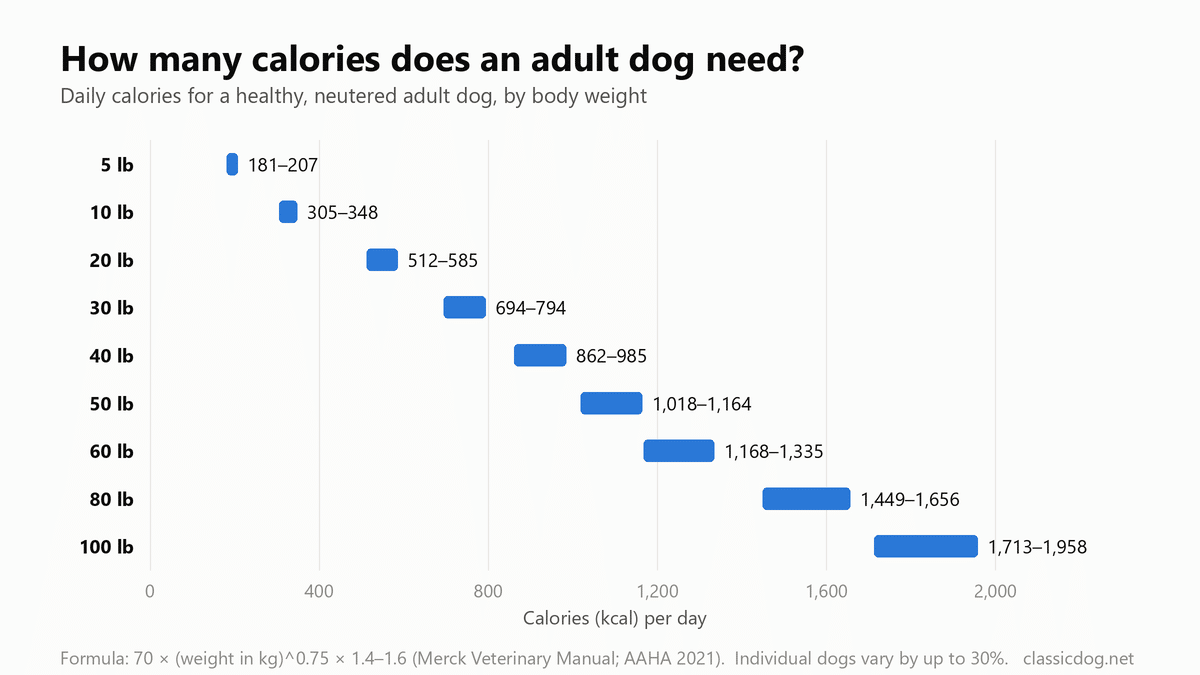
Step 2: multiply for the dog’s life. Resting energy is then multiplied by a factor for the dog’s life stage and lifestyle. A neutered adult gets 1.4 to 1.6, so our 22-pound dog needs roughly 550 to 630 kcal a day. Here’s what that looks like across different sizes:
These are the factors the calculator uses, taken from the 2021 AAHA Nutrition and Weight Management Guidelines:
| Your dog | Multiply resting energy by |
|---|---|
| Puppy under 4 months | 3.0 |
| Puppy, 4 months to adult size | 2.0 |
| Adult, neutered or spayed | 1.4 to 1.6 |
| Adult, not neutered | 1.6 to 1.8 |
| Adult, inactive or gains weight easily | 1.0 to 1.2 |
| Adult, very active (light work) | 1.6 to 2.0 |
| Weight loss (applied to ideal weight) | 1.0 |
For the “very active” option I used AAHA’s light work range. Dogs doing hard daily work, like herding or sled dogs, can need far more, and that’s a conversation for your vet.
Finding the calorie number on your dog food
To turn calories into an actual amount of food, you need one number from the bag: how many calories the food contains. It’s usually labeled as metabolizable energy and given in kcal per cup and kcal per kg. If you can’t find it on the bag, the brand’s website or customer helpline should have it.
The math is simple. If the label says 350 kcal per cup, our 22-pound dog needing 550 to 630 kcal would get about 1.6 to 1.8 cups a day, or roughly 0.8 to 0.9 cups per meal if you feed twice a day. If the label also gives kcal per kg, you can work in grams instead: at 3,700 kcal per kg, the same dog needs about 149 to 170 grams a day.
If you can, weigh the food on a kitchen scale rather than using a scoop. Scoops come in all sizes, and a heaping cup can hold noticeably more than a level one. An inexpensive digital scale takes the guesswork out.
Treats count too
The calculator’s calorie figure is everything your dog eats in a day, not just the main meals. The University of California, Davis vet school recommends that treats and extra food make up no more than 10% of daily calories, with the rest coming from a complete and balanced diet. For our 22-pound dog that’s a treat budget of about 55 to 63 kcal a day.
That isn’t much, so low-calorie treats help. UC Davis gives some examples: 50 g (about 1.8 oz) of raw baby carrots has about 18 kcal, and a medium strawberry about 4 kcal. They also list foods to keep away from dogs entirely, including chocolate, macadamia nuts, garlic, onions, grapes and raisins.
Feeding puppies
Growing puppies need much more energy for their size than adults. AAHA’s guidelines use a factor of 3 for puppies under 4 months and 2 from 4 months until they reach adult size, both applied to the puppy’s current weight.
Because puppies gain weight so quickly, the number goes out of date fast. Weigh your puppy and recalculate every couple of weeks, and follow your vet’s advice on the right food, especially for breeds that will be large as adults.
If your dog needs to lose weight
For weight loss, AAHA’s guidelines work out calories from the dog’s ideal weight, not its current weight, and use a factor of 1.0. That’s why the calculator asks for a target weight when you choose that option. A 66-pound (30 kg) dog that should weigh 55 pounds (25 kg) would start at about 783 kcal a day, instead of the 1,256 to 1,436 kcal a 66-pound neutered dog would normally get.
Please do this with your vet. They can confirm the target weight, rule out medical causes of weight gain and check the dog is losing at a safe pace.
The step most people skip: check and adjust
AAHA is clear that calorie intake should be adjusted by watching the dog’s body weight and body condition, meaning how much fat you can feel over the ribs and see around the waist. In practice that means feeding the calculated amount for a few weeks, weighing your dog, and then nudging the amount up or down by about 10% if the weight is moving the wrong way.
If your dog seems hungry all the time, loses weight without trying, or suddenly goes off food, that’s worth a vet visit rather than a recalculation.
Sources
- Merck Veterinary Manual. Nutritional Requirements of Small Animals. merckvetmanual.com
- Merck Veterinary Manual. Table: Daily Maintenance Energy Requirements for Dogs and Cats. merckvetmanual.com
- Cline MG, et al. 2021 AAHA Nutrition and Weight Management Guidelines for Dogs and Cats. Journal of the American Animal Hospital Association. 2021;57(4). aaha.org
- UC Davis School of Veterinary Medicine. Treat Guidelines for Dogs. vetmed.ucdavis.edu
Last reviewed: 14 October 2026. Written by Santosh Mahajan. This calculator gives a starting estimate and isn’t veterinary advice. Pregnant or nursing dogs and dogs with medical conditions need a plan from a vet. See the Disclaimer and the Editorial Policy.